
Whether you follow wider industrial transformations on Mind Wave Rise Home or analyze corporate management strategies in our Business Leadership & Management vertical, technological leadership is essential to establishing global market dominance. To explore how multinational energy equipment and industrial supply chains operate, visit our Global Trade & Logistics Analysis resource hub.
In this comprehensive, 2,000+ word ultimate guide, we will unpack the history, engineering capabilities, groundbreaking technological innovations, and global impact of the Halliburton Duncan Technology Center. We will evaluate its core research divisions, contrast modern energy technology against legacy field methods, explore its sustainability initiatives, and outline how the center drives value across the energy supply chain.
The Historic Roots and Evolution of Duncan’s Energy Hub
The story of the Halliburton Duncan Technology Center is inseparable from the history of Halliburton itself. Founded by Erle P. Halliburton in the early 20th century, the company revolutionized the petroleum industry by pioneering mechanical oil well cementing in Oklahoma. Duncan quickly became the beating heart of Halliburton’s operational and technological growth, serving as its primary research, training, and equipment fabrication base for decades.
Over the years, as drilling environments migrated from shallow land wells to ultra-deepwater basins and complex unconventional shale formations, the Duncan facility evolved into a high-tech powerhouse. Today, the Halliburton Duncan Technology Center brings together hundreds of elite scientists, chemical engineers, metallurgists, software developers, and field technicians working in unison to solve the energy sector’s most daunting physical and digital challenges.
To analyze risk mitigation frameworks for major energy assets and industrial infrastructure, explore our Risk Management & Asset Protection module. Learn how energy leaders scale enterprise portfolios in our Corporate Strategy & Growth Guide.
Core Technological Capabilities & Research Divisions
The Halliburton Duncan Technology Center houses several specialized scientific and engineering departments designed to address distinct phases of well design, construction, and stimulation:
1. Advanced Cementing Science and Material Chemistry
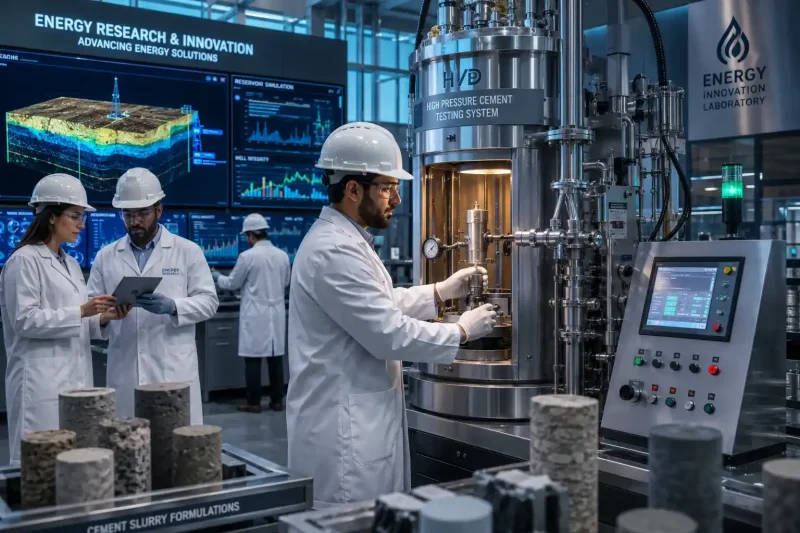
Well cementing is the critical process of pumping specialized cement slurries into the annular space between the casing and the geological formation. Proper cementing provides structural integrity, isolates permeable zones, and prevents fluid migration. The Duncan Technology Center operates the world’s most sophisticated cement research laboratories.
- High-Temperature / High-Pressure (HTHP) Testing: Simulating subterranean conditions exceeding 400°F and 20,000 psi to formulate specialized slurry mixes that withstand extreme geothermal environments.
- Elastic & Self-Healing Cements: Developing advanced flexible additives and responsive latex polymers that expand or self-seal upon contact with hydrocarbon leaks, guaranteeing long-term zonal isolation.
- Lightweight & Low-Carbon Slurries: Formulating sustainable, low-density cementing materials that reduce carbon intensity without compromising compressive strength.
For industrial real estate, laboratory infrastructure, and facility engineering standards, visit our Commercial Real Estate & Infrastructure page.
2. Hydraulic Fracturing & Stimulation Chemistry
Unconventional oil and gas reservoirs require precise hydraulic fracturing treatments to unlock trapped hydrocarbons. Duncan’s stimulation research laboratories focus on developing environmentally responsible friction reducers, crosslinked gels, and proppant transport fluids.
- Produced Water Recycling Technologies: Formulating specialized fluid systems capable of performing effectively using 100% recycled oilfield brine, minimizing fresh water usage.
- Micro-Proppant & Flow-Back Control: Engineering microscopic ceramic particles and resin-coated proppants designed to prop open micro-fractures and maximize long-term reservoir permeability.
Discover how artificial intelligence and real-time sensor networks are transforming subsurface engineering in our Future Tech & AI Innovations resource section.
3. Subsurface Tool Engineering & Precision Manufacturing
Beside chemical labs, the Duncan site includes high-precision mechanical engineering shops that design, build, and test mechanical tools. From automated downhole float equipment and centralizers to packer assemblies and multi-stage completion tools, Duncan engineers build hardware engineered to operate flawlessly under extreme downhole stress.
Explore how big data analytics optimizes drilling performance and well telemetry in our Business Data Analytics & AI section. Review corporate capital allocation strategies in energy ventures in our Corporate Finance & Budgeting guide.
Check out modern field testing hardware and industrial measuring tools in our Tech & Mobile Gadgets Guide.
Comparing Traditional Field Practices vs. Duncan Tech Innovations
| Operational Metric | Legacy Field Practices | Duncan Technology Integrated Solutions |
|---|---|---|
| Cement Slurry Testing | Basic ambient temperature lab testing | Simulated HTHP chamber testing up to 20,000 psi |
| Fracturing Fluids | Heavy reliance on fresh water sources | 100% recycled produced water chemical formulations |
| Well Integrity Assurance | Post-job acoustic logging days after pumping | Real-time fiber-optic acoustic and thermal monitoring |
| Chemical Dosing Accuracy | Manual surface mixing with wider error margins | Automated digital liquid additive control systems |
| Equipment Testing Protocol | Physical trial-and-error field deployments | Digital twin modeling paired with full-scale test wells |
| Environmental Impact | Higher chemical volume footprint | Biodegradable, low-toxicity green chemistry options |
For more on shifting global energy demands and consumer fuel trends, explore our Consumer Behavior & Retail Trends page. Track macroeconomic shifts affecting the energy sector in our Global Economy Trends index.
Full-Scale Simulation Facilities: Bringing Lab Science to the Field
One of the most impressive aspects of the Halliburton Duncan Technology Center is its collection of full-scale testing rigs and flow loops. Computer models and benchtop laboratory experiments are invaluable, but verifying physical tool behavior requires real-world scale.
At Duncan, engineers utilize full-sized yard test rigs and underground test wells to simulate actual downhole conditions. Cement slurries are pumped through full-diameter casing strings, fracturing fluids are run through thousands of feet of high-pressure piping, and mechanical tools are subjected to torsional, tensile, and compressive forces that mirror actual wellbores miles beneath the earth’s surface. This rigorous field validation guarantees that when technology leaves Duncan for deployment in the Permian Basin, the North Sea, or offshore Guyana, it works seamlessly the first time.
Driving Sustainability and Energy Transition Solutions
As the global energy sector evolves toward decarbonization, the Halliburton Duncan Technology Center is leading the development of sustainable, lower-carbon energy technologies. Key green initiatives managed at the facility include:
1. Carbon Capture, Utilization, and Storage (CCUS) Well Integrity
Permanently storing carbon dioxide ($CO_2$) deep underground requires cement sheaths and well seals that resist carbonic acid degradation. Duncan scientists have engineered acid-resistant cement systems that ensure permanent, leak-free storage for industrial CCUS projects globally.
2. Geothermal Energy Well Systems
Geothermal wells expose equipment to intense subterranean heat and highly corrosive brine chemistry. Duncan’s metallurgy and fluid teams develop specialized completion tools and high-temperature drill fluids tailored specifically for deep geothermal power development.
3. Hydrogen Storage and Well Sealing
As hydrogen emerges as a clean energy carrier, underground storage in depleted reservoirs or salt caverns presents new sealing challenges due to hydrogen’s tiny molecular size. Duncan’s materials teams are actively researching high-density polymers and non-porous sealing materials designed specifically for hydrogen containment.
To read about green industrial technology and carbon abatement solutions, visit our Sustainability & Green Tech section. Master facility operational workflows in Operations Management & Efficiency, and track energy sector market performance in Market Analysis & Performance Tracking.
For strategic business advice on industrial expansion, explore our Entrepreneurship & Business Growth section, read commercial energy updates in Commercial Industry Insights, or refine your strategic vision in our Lifestyle & Strategic Mindset hub.
Economic and Community Impact on Duncan, Oklahoma
Beyond its global technological contributions, the Halliburton Duncan Technology Center serves as an economic cornerstone for Stephens County and the state of Oklahoma. The center provides hundreds of high-paying technical jobs for research scientists, mechanical engineers, laboratory technicians, software architects, and skilled machinists.
Furthermore, the facility fosters close collaborations with major academic institutions, including the University of Oklahoma, Oklahoma State University, and Texas A&M University. Through STEM outreach programs, internships, and research grants, Halliburton Duncan helps cultivate the next generation of American scientific and engineering talent.
Conclusion: Shaping the Future of Global Energy
The Halliburton Duncan Technology Center stands as a shining testament to how human ingenuity, rigorous scientific research, and advanced engineering come together to solve humanity’s toughest energy challenges. By transforming raw scientific theory into high-performance field solutions, Duncan continues to elevate operational standards across the global energy industry.
As the world seeks higher energy efficiency, enhanced well safety, and sustainable low-carbon technologies, the Halliburton Duncan Technology Center remains at the forefront—driving innovation, fostering industry excellence, and powering progress for generations to come.
Frequently Asked Questions (FAQs)
1. What is the primary role of the Halliburton Duncan Technology Center?
The center serves as Halliburton’s flagship facility for research, development, chemical formulation, tool testing, and precision engineering across oilfield cementing, stimulation, completions, and digital well solutions.
2. Where is the Halliburton Duncan Technology Center located?
The facility is located in Duncan, Oklahoma, USA—the historic birthplace of Halliburton’s energy services operations.
3. How does the Duncan center contribute to environmental sustainability?
Duncan engineers develop recycled water fracturing fluids, low-carbon cement slurries, acid-resistant materials for Carbon Capture and Storage (CCUS), and specialized tools for geothermal energy wells.
4. What types of testing are conducted at the Duncan facility?
The facility performs High-Temperature / High-Pressure (HTHP) chemical testing, material fatigue analysis, fluid rheology testing, full-scale yard rig tool simulations, and subterranean flow loop testing.
5. Does the Duncan Technology Center support international energy operations?
Yes. Technologies, chemical formulas, and mechanical tools engineered at the Duncan Technology Center are deployed across onshore and offshore energy basins worldwide.