
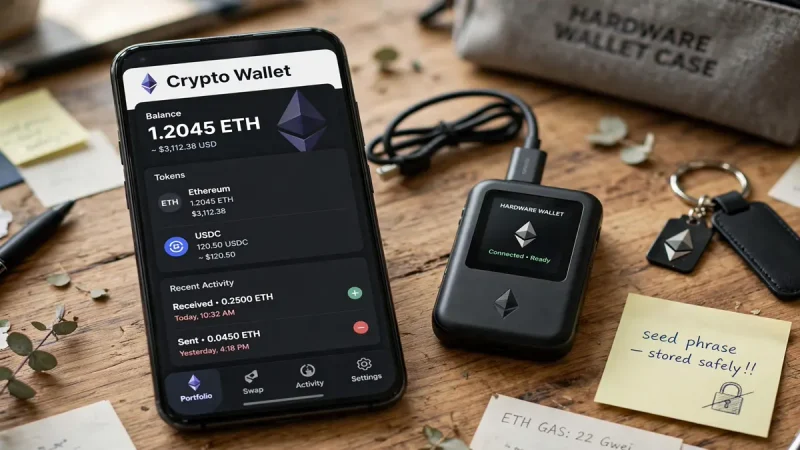

In this guide, you will find the top Ethereum wallets ranked by category: best overall, best for DeFi, best hardware, and best for beginners. Additionally, you will learn how to set up and secure your wallet properly. Let us find your perfect fit.
Quick Comparison: Top Ethereum Wallets
| Wallet | Type | Best For |
|---|---|---|
| MetaMask | Hot (browser/mobile) | Best overall, dApp compatibility |
| Rabby | Hot (browser) | DeFi power users |
| Ledger | Hardware | Long-term cold storage |
| Trezor | Hardware | Open-source cold storage |
| Trust Wallet | Hot (mobile) | Multi-chain mobile use |
| Coinbase Wallet | Hot (mobile/browser) | Beginners |
| Rainbow | Hot (mobile) | NFTs and clean mobile UX |
| Safe | Smart contract multisig | Teams and treasuries |
1. MetaMask — Best Overall
MetaMask remains the wallet Ethereum is built around, with roughly 30 million monthly active users. Virtually every dApp integrates it first, so connections rarely fail.
In addition, it now supports Ethereum, major Layer 2s, Solana, Bitcoin, and TRON. Additionally, one-click smart accounts let you batch transactions and pay gas in stablecoins. However, the in-wallet swap fee near 0.875% is higher than external aggregators.
Warning: MetaMask is the most impersonated brand in crypto. In fact, Download only from the official site and scrutinize every signing prompt.
2. Rabby — Best for DeFi
Rabby has become the favorite of active DeFi users. Its standout feature is transaction simulation: it shows you exactly what will happen before you sign.
Moreover, it supports 140+ EVM chains with smooth automatic switching. If you sign transactions weekly across multiple protocols, Rabby’s clarity is unmatched.
Furthermore, Pair it with a Ledger for the ideal setup: Rabby for daily DeFi, hardware for custody of larger balances.
3. Ledger — Best Hardware Wallet
For long-term holders, nothing beats cold storage. Ledger devices keep private keys offline, safe from hacks and phishing. Moreover, the Ledger Stax and Flex are the current flagships.
Ledger Live manages 5,500+ assets, and the devices pair with MetaMask and Rabby for dApp use. If you hold meaningful ETH, a hardware wallet is not optional — it is essential.
4. Trezor — Best Open-Source Hardware
Furthermore, Trezor appeals to users who value fully open-source security. The Trezor Safe 5 offers a touchscreen and Shamir backup for splitting recovery seeds.
It integrates with Trezor Suite and external wallets for Ethereum and Layer 2s. Additionally, for the security-conscious, Trezor’s transparency is a decisive advantage.
5. Trust Wallet — Best Multi-Chain Mobile
Trust Wallet supports 100+ blockchains natively, making it ideal if you hold assets beyond Ethereum. The mobile app is polished and beginner-friendly.
In fact, Built-in staking, a dApp browser, and NFT support round out the package. It is a solid all-rounder for mobile-first users.
6. Coinbase Wallet — Best for Beginners
New users benefit from the simplest onboarding. Furthermore, passkey recovery means no seed phrase to lose — a huge relief for first-timers.
It connects cleanly to Base and Ethereum dApps. Start here if crypto wallets intimidate you, then graduate to MetaMask or Rabby as you learn.
How to Choose the Right Wallet
In addition, Match the wallet to your behavior. Daily DeFi user? Rabby. Long-term holder? Ledger or Trezor. NFT collector? Rainbow. Complete beginner? Coinbase Wallet.
The strongest setup is not one wallet but a stack: a hot wallet for activity plus a hardware wallet for savings. Moreover, Never keep significant funds in a hot wallet alone.
For teams, DAOs, or shared family funds, use Safe’s multisig. Furthermore, it requires multiple approvals for every transaction, eliminating single points of failure.
Security Rules Everyone Must Follow
Write your recovery phrase on paper and store it offline. In addition, Never screenshot it, never save it in the cloud, and never type it into any website.
Always download wallets from official sites only. Fake browser extensions and ads are the top attack vector. In fact, bookmark the real URLs.
Send a small test transaction before moving large amounts. This simple habit has saved countless users from costly address mistakes.
Use a separate “burner” wallet for risky mints and unknown airdrops. Furthermore, keep your main holdings isolated from experimentation.
Frequently Asked Questions
What is the safest Ethereum wallet?
Hardware wallets (Ledger, Trezor) are safest because keys stay offline. For hot wallets, Rabby and MetaMask lead with strong security track records.
Is MetaMask still the best Ethereum wallet?
For general use and dApp compatibility, yes. Moreover, for active DeFi, many now prefer Rabby’s transaction simulation. Most experts recommend pairing either with hardware.
Can I store Bitcoin in an Ethereum wallet?
Furthermore, some multi-chain wallets like MetaMask, Trust Wallet, and Phantom now support Bitcoin alongside Ethereum. Pure Ethereum wallets cannot.
Do I need a hardware wallet for small amounts?
Not necessarily. Hot wallets are fine for small, active balances. Additionally, once holdings become meaningful to you, move the bulk to cold storage.
What happens if I lose my recovery phrase?
Without it, your funds are permanently unrecoverable — no company can help. In fact, this is why offline paper backup is non-negotiable.
Conclusion
The best-performing Ethereum wallets in 2025 suit different needs, but the winning formula is consistent: a quality hot wallet for activity plus hardware for savings.
For more crypto guides, explore our cryptocurrency section.
As Ethereum continues to evolve, so too does the landscape of cryptocurrency trading, where the interplay between security and strategy becomes increasingly crucial. Choosing the right wallet is merely the first step; understanding how to effectively leverage your assets for trading is paramount. The best-performing wallets not only provide a secure environment for your Ethereum but also facilitate seamless integration with various trading platforms and decentralized applications. This integration is vital for traders looking to employ diverse tactics, whether it’s through long-term investing or more dynamic approaches. For those keen on enhancing their trading acumen, a robust cryptocurrency trading strategy can be the differentiator between mere participation and substantial success in this volatile market.

