

Here’s my problem with most China guides: they hand you the same ten sights in the same order, as if every traveler wants the same trip. But you don’t — and that’s exactly the point. The history nerd and the mountain hiker and the dumpling obsessive are planning completely different journeys — they just happen to share a country. So let’s do this differently. Tell me what kind of traveler you are, and I’ll tell you which China is yours.
Because China is genuinely several countries wearing one name: five thousand years of history, deserts, tropics, megacities, and villages where water buffalo still plow the fields. The most popular places to visit in China cover all of it. So your job is simple: pick your flavor.
Which China Are You Traveling? Pick Your Style
The Time Traveler lives for ancient stones and dynasties. Your China is Beijing’s Forbidden City, Xi’an’s Terracotta Army, and Pingyao’s Ming-dynasty walls. The Wild Seeker wants landscapes that don’t look real: Zhangjiajie’s floating pillars, Guilin’s karst peaks, Jiuzhaigou’s turquoise lakes. The Urban Explorer chases skylines and street food in Shanghai, Hong Kong, and Chengdu. The Flavor Hunter plans entire days around meals — and honestly, that’s the smartest strategy of all.
Most travelers are a mix. That’s fine. Read the sections that call to you, then stitch them into a route at the end. This china travel guide is built to be remixed.
For the Time Traveler: Beijing and Xi’an
Start in Beijing, because eight centuries of emperors left their mark here and it’s all still standing. The Forbidden City is almost absurd in scale — 980 buildings, 8,728 rooms, and you walk the same central axis the emperors did. So go at opening time. By noon it’s a river of tour groups; at 8:30 it’s practically yours.
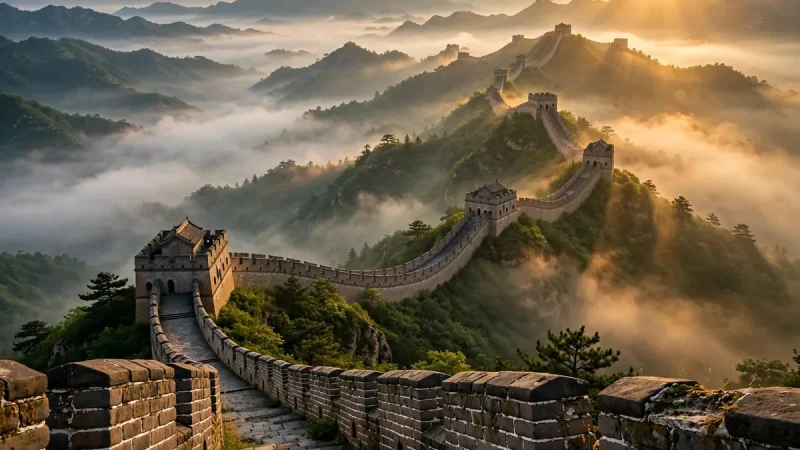
Then the Great Wall, which deserves a full day and some honesty about which section to pick. Badaling is the closest and the most crowded. Mutianyu is the sweet spot: gorgeous, restored, half the crowds, plus a toboggan ride down. Jinshanling is for hikers who want wild, crumbling ramparts and bragging rights. So pick the one that matches your legs and your patience.
Two hours by bullet train southwest, Xi’an guards the single most astonishing archaeological site on earth. The Terracotta Army — 8,000 life-sized soldiers, each with a unique face — was buried with China’s first emperor and found by farmers in 1974. Pit 1 alone holds around 6,000 warriors in formation. When you stand on the viewing platform trying to process the scale, give it a full minute. I’ll wait.
Xi’an the city is worth a day beyond the warriors. Cycle the 14-kilometer Ming city wall, then eat your way through the Muslim Quarter: hand-pulled biangbiang noodles, persimmon cakes, lamb skewers. But here’s what first-timers miss: Xi’an was the eastern end of the Silk Road, so its food and culture carry Central Asian fingerprints you won’t taste anywhere else in China. Because of that history, even the street snacks tell a story. Your Time Traveler route is Beijing (4 days) → Xi’an (2 days), and you’ll never look at history the same way.
For the Wild Seeker: Zhangjiajie, Guilin, and Huangshan
While some landscapes you photograph, others make you just stand there, quietly losing your mind. Southern China’s karst country is the second kind.
Zhangjiajie is the headliner: over 3,000 quartz-sandstone pillars shooting hundreds of meters into the sky, usually wrapped in mist. Yes, these are the “Avatar mountains.” Then ride the Bailong Elevator up a cliff face in under two minutes, walk the glass bridge if your nerves allow, and give the park two full days — it’s enormous and the weather changes everything. Misty days are actually the most magical, when pillars fade in and out like a dream.
Then Guilin and Yangshuo, where the Li River winds between limestone towers straight out of a classical painting. Still, the cruise from Guilin to Yangshuo remains one of the world’s great scenic journeys. In Yangshuo, though, the real move is renting a bike and riding past rice paddies and water buffalo. At dawn, climb Xianggong Hill for the postcard panorama. Our best places to visit in China for nature guide goes deeper on all of these.
If you have a third nature stop in you, make it Huangshan — the Yellow Mountain. Granite peaks, twisted pines, seas of clouds: it’s been China’s most painted mountain for a thousand years, and sunrise from the summit is a legitimate life event. Still, a word of warning for Wild Seekers: these landscapes demand real walking. The viewpoints are earned on stone staircases, sometimes thousands of steps. So pack proper shoes, start early, and let the slower travelers have the cable cars.
For the Urban Explorer: Shanghai and Hong Kong
Want the China of the future? Shanghai’s Pudong skyline looks like a sci-fi film set — ride the world’s fastest elevators up the Shanghai Tower, then cross the river to the Bund, where 1920s colonial facades glow at night. The contrast between the two riverbanks is the whole story of modern China in one view.
Don’t miss the old city, though. Yu Garden’s Ming-dynasty rockeries and zigzag bridges sit minutes from the towers. The French Concession’s tree-lined streets hide the city’s best cafés. And the high-speed rail makes day trips effortless: Suzhou’s classical gardens in 30 minutes, Hangzhou’s West Lake in an hour.
Hong Kong, meanwhile, is the perfect bookend — Cantonese soul, global polish, and the single best harbor view in Asia. Ride the Star Ferry (it’s been running since 1888 and costs almost nothing), take the Peak Tram for the panorama, and eat everything: dim sum at dawn, dai pai dong noodles at midnight. The MTR runs like clockwork, so even a two-day stopover works. Pair it with Seoul in autumn or Thailand with family and you’ve got a proper Asia circuit.
For the Flavor Hunter: Chengdu and Beyond
Real talk: you could plan an entire China trip around food, and it would still be magnificent. Start in Chengdu, the capital of Sichuan cuisine and China’s most lovable big city. Teahouses full of mahjong players, pandas napping in bamboo groves, and the famous mala flavor — that numbing-spicy tingle — in everything from mapo tofu to dan dan noodles.
The Giant Panda Breeding Research Base, though, is non-negotiable. Go before 9 a.m. when the pandas are awake and eating; by afternoon they’re professional sleepers. Over a hundred pandas live here, plus red pandas, in genuinely lovely enclosures.
Chengdu also unlocks two heavyweight side trips: Jiuzhaigou Valley’s impossible blue lakes, and the 71-meter Leshan Giant Buddha carved into a cliff in the 8th century. And honestly? Every city on this list has its own food pilgrimage — Peking duck in Beijing, soup dumplings in Shanghai, roast goose in Hong Kong. Yet Chengdu locals will tell you, with total confidence, that their city eats best. After a week of mala spice and teahouse afternoons, you might start agreeing. Eat widely. This is not the trip for diets.
Money, Phones, and Other Unsexy Essentials
Let’s talk logistics, because they make or break China trips. First, money: China runs on mobile payment, and cash is increasingly useless in big cities. So sort out a working payment method before you land — your hotel can’t help you at midnight when the taxi app won’t take your card. Second, your phone: get your connectivity handled in advance, because you’ll lean on maps and translation apps constantly.
Third, the language gap is real but totally manageable. Outside top hotels, English is rare. But translation apps are excellent now, and a smile plus ten words of Mandarin opens doors. Learn “ni hao” (hello), “xie xie” (thank you), and “tai gui le” (too expensive) — the last one is for markets, and vendors love it when you try. Finally, trains: book high-speed tickets a few days ahead for popular routes, because they do sell out on weekends.
The 14-Day Route That Actually Works
So — time to stitch it together. Here’s a route that balances the greatest hits with breathing room:
Days 1–4: Beijing. Forbidden City, Great Wall (Mutianyu), hutongs, Peking duck. Days 5–6: Xi’an. Terracotta Army, city wall cycle, Muslim Quarter feast. Days 7–9: Zhangjiajie or Guilin. Pick one nature stop — don’t try both. Days 10–11: Chengdu. Pandas, Sichuan food, teahouse lingering. Days 12–14: Shanghai. Skyline, Bund, day trip to Suzhou or Hangzhou. Fly home (or add Hong Kong).
China’s bullet trains are a highlight in themselves, not just transport — because at 350 km/h, city center to city center, the journey is half the fun. Book on the official app. For the popular places to visit in China on a global scale, see how they rank among the top most visited places in the world.
Before You Go: The Honest Checklist
☐ Visa: most nationalities need one — apply weeks ahead, not days. ☐ Money: mobile payment rules daily life; set up an international-friendly option before you land. ☐ Connectivity: sort out your internet situation in advance (you know why). ☐ Timing: avoid Golden Week (early October) and Chinese New Year unless you enjoy crowds at maximum density. ☐ Language: download a translation app and learn ten words of Mandarin — effort earns enormous goodwill.
Spring (April–May) and autumn (September–October) are the sweet spot for most destinations. Summer is hot and crowded; winter is cheap and empty, with Harbin’s ice festival as the frozen bonus. Our Japan off-the-beaten-path guide and Kuala Lumpur city guide pair well if you’re building a bigger Asia trip.
Three Myths About Traveling in China
“It’s too difficult for independent travelers.” The high-speed rail, modern subways, and translation apps have changed everything. Millions of foreigners travel China independently every year. “The food will be a challenge.” Only if you want it to be — China’s regional cuisines are among the world’s greatest, and pointing at pictures works everywhere. “You need a month to see anything.” Still, two focused weeks on the route above covers the icons. Depth beats breadth, but the icons are genuinely iconic.
So… Which China Is Yours?
Here’s what I hope you take from this: there’s no single “correct” China trip. The Time Traveler’s Beijing-Xi’an run and the Wild Seeker’s karst pilgrimage are completely different journeys through the same country — and both are right.
So start with your style, steal the route above, and leave room for the unplanned. Somewhere between a misty mountain and a midnight noodle bowl, China stops being a destination on your china bucket list and becomes a story you tell for years. The must-visit places in Ho Chi Minh City make a natural next chapter if Southeast Asia calls afterward. And when you’re dreaming up the trips after that, our 1001 places to visit before you die list is waiting. Where will you go first?

