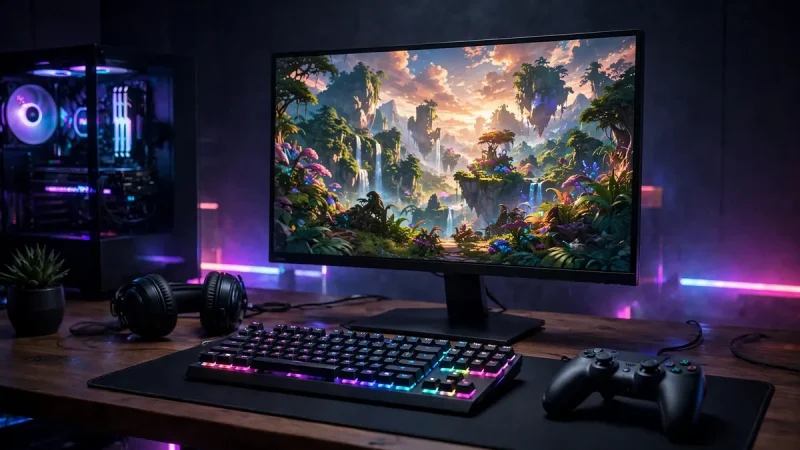

Quick — picture a gamer. Did you imagine a teenager in a dark basement? That image is about thirty years out of date. The average player today is in their thirties, plays on a phone during lunch breaks, and is as likely to be a parent as a student. Meanwhile, the video games entertainment industry quietly became the biggest show in town — bigger than Hollywood, bigger than the music business. How did that happen? Let us bust the myths one by one, because the real story is wilder than you think.
Myth #1: “Gaming Is Just a Kids’ Thing”
This is the myth that refuses to die, so let us kill it with demographics. The average gamer is now in their mid-thirties. Parents play with their kids. Grandparents play puzzle games on tablets. Your boss probably has a mobile game they will not admit to. Gaming did not stay young — its audience grew up and kept playing.
Why does this matter? Because an adult audience changed what games became. Developers started making games about grief, parenthood, moral choices, and midlife crises — stories with the emotional weight of prestige TV. When millions of adults with disposable income embraced gaming, the industry’s creative ambitions exploded. Kids still play, obviously. But they are no longer the center of the universe.
Think about your own circle. I bet you know at least three people who play regularly and zero who fit the basement stereotype. The myth survives on old sitcom jokes, not reality. And the numbers back this up — gaming’s audience is broader by age, gender, and geography than any other entertainment medium. That breadth is the foundation of everything else in this article.
Myth #2: “Movies Are Still the Biggest Entertainment”
Time for the money talk, because this one surprises everyone. The global video game industry generates well over $180 billion a year, according to market trackers. Now compare: worldwide box office hovers around a fraction of that, and recorded music smaller still. Gaming does not just lead — it laps the field. Combined, movies and music still do not catch up.
But raw revenue only tells half the story. Look at engagement. A blockbuster film asks for two hours of your attention. A great game asks for eighty — and players happily give it. They return nightly, bring friends, and spend years in a single virtual world. No film franchise commands that kind of sustained attention. It is not even close.
And here is the kicker: gaming proved nearly recession-proof. When money gets tight, people cut the $200 concert tickets but keep the $15 game subscription. Free-to-play titles keep millions entertained for literally zero dollars. So while box office numbers swing wildly with hits and flops, gaming revenue climbs with metronome steadiness. Investors noticed. Hollywood noticed. Everyone noticed.
Curious how the film side measures success? Our coverage of Avatar’s box office collection and its day-wise breakdown shows the movie industry’s very different scoreboard.
Myth #3: “Games Can’t Tell Stories Like Films”
Oh, this one. Let us settle it with a question: when was the last time a movie made you personally responsible for a character’s fate? Games do something no passive medium can — they hand you the choices. Do you save the village or chase the villain? Do you trust the stranger? Your decisions, your consequences, your guilt. That is not just storytelling; it is storytelling with stakes.
The craft caught up with the ambition years ago. Today’s narrative games employ Hollywood screenwriters, Oscar-caliber actors doing full motion capture, and composers writing sweeping orchestral scores. Branching storylines mean your playthrough genuinely differs from mine — we experienced different stories from the same game. Try getting that from a Blu-ray.
Still skeptical? Look at the adaptation wave. Prestige TV series based on games now win awards and dominate cultural conversation. Studios are racing to option game franchises the way they once chased comic books. The talent flows both directions — and honestly, some of the best writing in entertainment right now is happening on consoles. For more on entertainment’s digital shift, see how digital experiences are revolutionizing entertainment.
Myth #4: “Mobile Games Don’t Count as Real Gaming”
Gatekeepers love this one. “Oh, you play on your phone? That is not real gaming.” Meanwhile, mobile titles generate the majority of industry revenue. Billions of people game on phones — in markets where consoles never even arrived. Dismissing mobile gaming is like dismissing paperbacks because they are not hardcovers. It is snobbery, not analysis.
Mobile did something profound: it made gaming universal. Your mom, your taxi driver, your grandmother — all gamers now, whether they use the word or not. Puzzle games, word games, farming sims: these are not lesser experiences, they are different ones, designed for short sessions and broad appeal. And the design craft in top mobile titles is genuinely impressive.
The ripple effects are everywhere. Music stars debut songs inside game worlds. Fashion houses sell digital outfits for avatars. Advertisers chase gaming audiences with Hollywood-sized budgets. Mobile did not just expand gaming — it dragged the entire entertainment industry into gaming’s orbit. The tail now wags the dog, and the dog is fine with it.
Myth #5: “Esports Isn’t a Real Sport”
Let us define “real sport”: professional competition, trained athletes, massive audiences, serious money. Esports checks every box. Stadiums sell out. Millions watch online. Prize pools reach eight figures. Players train with coaches, analysts, and nutritionists. Universities offer scholarships. What exactly is missing?
The “it is just button-mashing” crowd has clearly never watched a pro match. Elite players make hundreds of decisions per minute with the strategic depth of chess and the reflexes of table tennis. Teams study opponents’ tendencies for weeks. The mental game — pressure, tilt, clutch performance — mirrors any traditional sport. Ask a pro about their training schedule and prepare to feel lazy.
Here is what I find most interesting: esports is winning the demographic war. Young audiences that abandoned cable TV show up for tournaments in droves. Broadcast networks now air esports. Celebrity owners bring crossover buzz. The line between “esports” and “sports” gets blurrier every year — and the momentum is all one direction.
Myth #6: “Watching Other People Play Is Weird”
Is it? Because watching other people play sports is a multi-billion-dollar industry nobody questions. Game streaming works the same way — personality, skill, drama, community. Top streamers draw audiences that dwarf cable news. For millions, watching a favorite streamer is the evening’s entertainment, full stop.
Streaming also rewired how games succeed. A charismatic streamer playing an obscure indie title can turn it into a phenomenon overnight — free marketing to a deeply engaged audience. Developers now design “streamable moments” into games deliberately. And viewers are not passive: they chat, vote, donate, and shape the broadcast live. It is interactive television that television never figured out how to be.
Think of it this way: every entertainment medium eventually gets a spectator layer. Sports did. Cooking did. Gaming was never going to be the exception — it was going to be the biggest example. The numbers say it already is.
Myth #7: “The Technology Has Plateaued”
Every few years someone declares gaming tech “mature,” and every few years they look silly. Right now, three waves are building. Cloud gaming streams console-quality titles to basic phones — no expensive hardware needed. AI is generating vast worlds and smarter characters, letting tiny teams build what once required hundreds. And VR/AR, while slower than hyped, keeps improving in comfort and price.
But the quiet revolution is in feel. Near-instant loading killed the waiting game. Advanced haptics let you feel rain, tension, and texture through a controller. High-refresh displays make motion buttery. These are not spec-sheet bullet points — they fundamentally change how immersive games feel moment to moment.
Want to upgrade your own setup? Start with the senses: great audio transforms immersion, so check our guide to top noise-canceling headphones. Then look at smart devices that level up your space, and keep an eye on emerging gaming technology. The future arrives one gadget at a time.
Hold On — What About the Downsides?
Fairness demands we pause here, because no honest guide ignores the problems. Gaming addiction is real, and it deserves serious conversation rather than dismissal. Similarly, certain monetization tricks — looking at you, predatory loot boxes — have rightfully drawn regulators’ attention. Developers, too, face crunch culture, where brutal overtime mars the creation of beloved titles.
Yet acknowledging problems is a sign of maturity, not weakness. The industry now funds research into healthy play, while several countries have forced fairer monetization rules. Studios are slowly confronting crunch, though progress remains uneven. Meanwhile, players themselves push for better: review-bombing exploitative games, celebrating ethical studios, demanding accessibility features. So the myths are dead, but the work is not finished — and that is exactly how a grown-up industry behaves.
The Myths Are Dead. So What Comes Next?
Here is my honest prediction: gaming’s lead keeps growing, because every tailwind favors it. Each new generation grows up with games as the default entertainment. Technology keeps lowering barriers — cheaper devices, cloud streaming, AI-assisted creation. And creativity keeps raising the ceiling — the best game stories of the next decade have not been told yet.
Watch three frontiers. Persistent virtual worlds already host concerts, graduations, and protests — the “metaverse” buzzword may have cooled, but the reality keeps growing. Educational gaming is quietly huge: surgical simulators, history you can walk through, language practice with actual conversation. And indie creativity — small teams making weird, personal, brilliant games — keeps proving that vision beats budget.
There are real challenges, and we should name them: addiction concerns deserve honesty, monetization tricks like predatory loot boxes need regulation, and crunch culture still haunts big studios. A mature industry faces its problems instead of hiding them. Gaming is growing up — which is fitting, since its audience did long ago.
For a sense of how gaming reshapes adjacent industries, read how gaming is transforming digital marketing and where the VR industry stands now.
Your Move: Where Do You Fit In?
So — which myth did you believe? Be honest. Most people held at least one of these, because the old narrative was everywhere. But now you know: gaming is the biggest, most engaging, fastest-growing entertainment industry on earth, and it got there by being more interactive, more social, and more resilient than everything else.
If you have never really played, there has never been a better on-ramp. Cozy farming sims, gripping narrative adventures, quick mobile puzzles — pick your flavor. Most platforms offer free trials, and gaming communities love guiding newcomers. And if you are already a player? You are part of the biggest cultural shift in modern entertainment. Not bad for a “kids’ thing.”