
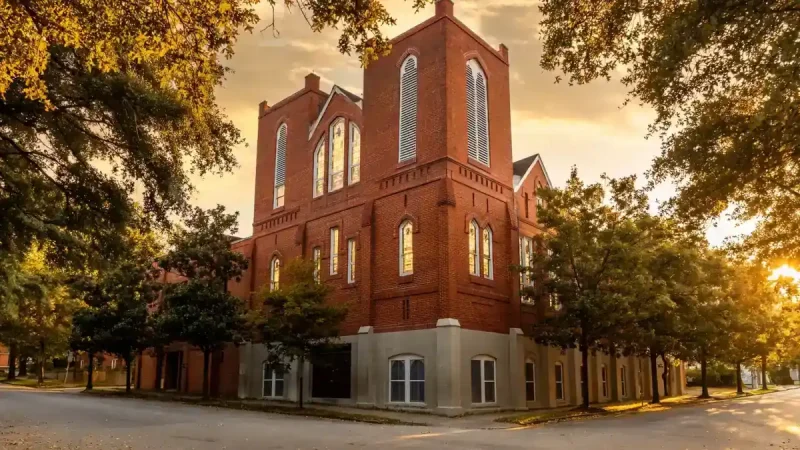

Close your eyes for a second. Picture a quiet brick street in Atlanta, 1929. A boy pedals past barbershops and churches, unaware that the whole world will one day know his name. Now picture yourself standing on that same street. That’s the trip we’re taking today — not a lecture, but a road trip through Martin Luther King Jr.’s America. Pack a bag. We’re following in his footsteps, city by city, and I’ll show you exactly what to see at each stop.
Stop One: Atlanta — Where the Story Begins
Every great story has a beginning, and King’s starts at 501 Auburn Avenue in Atlanta, Georgia. He was born here on January 15, 1929, in a modest two-story home. The house still stands, and rangers lead free tours through its rooms. You can see the bedroom where he was born. It hits differently when you’re actually in the room.
The surrounding Sweet Auburn district was once called the richest Black street in the world. Back then it buzzed with businesses, music, and church life. That energy shaped young Martin more than any textbook could. Walk the sidewalks slowly here. Read the historic markers. Grab lunch at a local spot and just soak it in.
Two doors down in spirit — well, a short walk away — sits Ebenezer Baptist Church. King’s father and grandfather both preached from its pulpit. Young Martin grew up in these pews, and the church later became a headquarters for the movement. Services still happen here, and visitors are welcome. If your timing lines up, attending one is unforgettable.
Right next door you’ll find the King Center, founded by Coretta Scott King in 1968. Inside are exhibits on his life, his Nobel Peace Prize, and rooms of personal papers. Outside, the reflecting pool invites a quiet minute. Before you leave Atlanta, take that minute. You’ll need it.
Quick check — is Atlanta your kind of stop? Love history you can touch, gospel music, and soul food? Then yes. Planning a fall visit? These best places to visit in Georgia during fall pair perfectly with the King sites.
Stop Two: Montgomery — Where a Bus Seat Sparked a Movement
Now point the car west to Montgomery, Alabama. In 1954, a 25-year-old King arrived to pastor Dexter Avenue Baptist Church. He expected a quiet pastoring job. History had other plans.
The church itself is small — a humble brick building steps from the Alabama State Capitol. That contrast is the whole story in one photograph: a little church staring down the seat of segregationist power. Inside, King’s office looks almost exactly as he left it. Stand at the pulpit where he found his voice, and you’ll understand why people followed him.
Then came December 1955. Rosa Parks was arrested for refusing to give up her bus seat, and the Black community of Montgomery stopped riding the buses. For 381 days. Let that number sink in — 381 days of carpools, walking miles to work, and standing firm. King, barely 26, became the boycott’s spokesman. His house was bombed. He answered with nonviolence.
Here’s a try-it-yourself moment: when you visit, walk a few blocks of the old boycott routes instead of driving. Your feet will ache long before the mile mark. Then remember — people did this daily for over a year. History stops being abstract real fast.
Mini-Quiz: Which King Stop Matches Your Travel Style?
Not everyone travels the same way, so let’s match the stops to you. Answer honestly:
1. Your ideal morning is… (a) a guided walking tour with stories at every corner, (b) a quiet museum where you can read everything, (c) standing exactly where history happened, (d) a scenic drive with stops along the way.
2. You travel for… (a) food and culture, (b) deep learning, (c) powerful moments, (d) the open road.
Mostly A’s? Atlanta’s Sweet Auburn is your place. Mostly B’s? You’ll love the museums in Birmingham and Memphis. Mostly C’s? Head straight for the Lincoln Memorial steps and the Lorraine Motel balcony. Mostly D’s? The Selma-to-Montgomery route was made for you.
Stop Three: Birmingham — The City That Tested Everything
Birmingham in 1963 was one of the most segregated cities in America. King and his colleagues chose it deliberately. The logic was blunt: expose the brutality, and the nation would have to face it. It worked — but the cost was enormous.
Start at the 16th Street Baptist Church, which served as movement headquarters. In September 1963, a bomb planted by white supremacists killed four young girls inside. The church still holds services today, and the congregation welcomes visitors with remarkable grace. Across the street, Kelly Ingram Park tells the rest through sculpture.
That park is where the Children’s Crusade unfolded. In May 1963, thousands of young students marched peacefully out of the church — and were met with fire hoses and police dogs. Cameras caught it all. When those images hit the evening news, public opinion across America shifted. Teenagers changed history from that park. Remember that the next time someone says young people can’t make a difference.
While you’re here, visit the Birmingham Civil Rights Institute next door. Its exhibits walk you from segregation’s daily humiliations to the movement’s victories. And here’s a detail most visitors miss: King wrote his famous “Letter from a Birmingham Jail” in a cell not far from here, defending nonviolent protest in prose that students still study today.
Stop Four: Selma — 54 Miles That Changed Voting Forever
Selma, Alabama, doesn’t look like much at first glance. That’s exactly why what happened here matters. In 1965, Black citizens who tried to register to vote faced beatings, firings, and rigged “literacy tests.” Local activists had been fighting for years before King arrived to amplify their cause.
The Edmund Pettus Bridge is the heart of it. On March 7, 1965 — Bloody Sunday — marchers crossed this bridge and were attacked by state troopers with clubs and tear gas. The footage horrified the nation. Two weeks later, under federal protection, thousands marched the full 54 miles to Montgomery. Five days of walking, camping in fields, and singing. At the Capitol steps, King spoke of perseverance — and within months, the Voting Rights Act became law.
You can drive the march route today in about an hour, with interpretive markers along the way. But here’s my suggestion: stop at the bridge first and walk across it slowly. Read the plaques. Look at the Alabama River below. Then drive the route. You’ll feel the distance in a way no documentary delivers.
Stop Five: Washington, D.C. — The Speech the World Remembers
August 28, 1963. A quarter of a million people filled the National Mall, and a 34-year-old preacher stepped to a podium on the Lincoln Memorial steps. “I have a dream,” he said — and the words outlived him.
Go stand on those steps. There’s an inscription marking the exact spot where he stood. From there, the Reflecting Pool stretches out like a mirror, and you can almost hear the crowd. It’s touristy, sure. Go anyway. Some places earn their crowds.
While you’re on the Mall, walk to the Martin Luther King Jr. Memorial, opened in 2011. The 30-foot “Stone of Hope” shows King emerging from granite, with his quotes carved into the walls around him. Its placement is deliberate — between Lincoln and Jefferson, linking his dream to the nation’s founding promises. If you’re building a D.C. itinerary, these unique places to visit in Washington, D.C. round out the trip nicely.
Final Stop: Memphis — Where the Journey Ended
Memphis is the hardest stop, and you shouldn’t skip it. King came here in April 1968 to support striking sanitation workers carrying “I Am a Man” signs. He saw their fight as part of his larger war on poverty. On April 4, he was assassinated on the balcony of the Lorraine Motel.
The motel is now the National Civil Rights Museum. His room — Room 306 — remains exactly as it was, right down to the coffee cups. The exhibits trace the movement from slavery through King’s death and beyond. Give it at least three hours. You’ll need the time, and honestly, you’ll need a quiet bench afterward.
The night before he died, King spoke at Mason Temple and delivered the “Mountaintop” speech — the one where he said he’d seen the Promised Land. Standing in that sanctuary today, knowing what came the next day, is one of the most haunting experiences in American travel. Before you leave Memphis, find the “I Am a Man” plaza near the museum. Those four words carried the whole strike, and they still echo.
Your Turn: The Practical Playbook
Enough inspiration — let’s talk logistics. Here’s how to actually pull this trip off.
When should you go? Spring and fall are ideal; Southern summers are brutally hot. MLK Day weekend in January brings special events at most sites, but book hotels early. Winter means thinner crowds and easier parking.
How do you string the stops together? The classic route is Atlanta → Montgomery → Birmingham → Selma → Memphis. That’s roughly 8–10 hours of total driving spread over 5–7 days. Fly into Atlanta, rent a car, and loop back — or finish in Memphis and fly home from there. For extra inspiration, this collection of 1001 places to visit before you die might spark detour ideas, and these surreal places to visit in the U.S. make great bonus stops.
What should you pack? Comfortable walking shoes — non-negotiable. Water and sun protection for the outdoor sites. A small notebook, because you’ll want to write things down. And before you go, read the “I Have a Dream” speech and the Birmingham letter. They take twenty minutes total, and they’ll transform every site you visit.
Traveling solo? These travel tips for solo travelers cover safety and confidence on the road. Looking for a summer version of the trip? Check this summer’s top travel destinations for seasonal ideas.
One Last Question
Travelers often ask me: with so many historic sites in America, why do King’s places hit harder? I think it’s this — at every stop, ordinary people did extraordinary things. Teenagers faced fire hoses. Maids walked miles instead of riding buses. A 26-year-old preacher with a new baby at home stood up anyway.
So here’s my challenge: don’t just visit. Pick one stop and go deeper — talk to a guide, attend a service, walk the extra mile. Then bring the story home and tell someone. That’s how a road trip becomes something more. That’s how his dream keeps moving.
Quick answers travelers ask me: Yes, you can do Atlanta, Montgomery, Birmingham, Selma, and Memphis in one week. Yes, most sites are affordable or free — the King Center and many churches cost nothing. And yes, kids absolutely should come; Birmingham’s Institute and Memphis’s museum both handle young visitors thoughtfully.

