
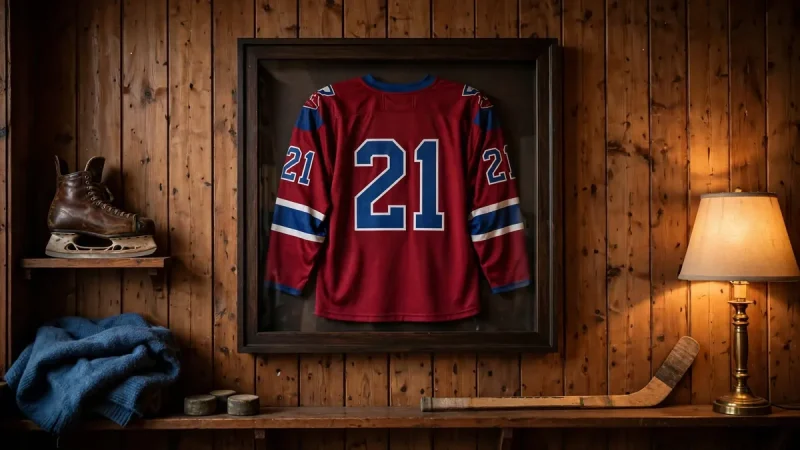

It usually starts with a photo. You’re scrolling, half-distracted, when a burgundy-and-blue sweater stops your thumb cold. Number 21. The crest with the mountain and the puck. Suddenly you’re twelve years old again, watching a Swedish magician dismantle an entire defense.
That’s the pull of a Peter Forsberg jersey. It’s not fabric and stitching — in fact, it’s a time machine. And if you’ve felt that tug, this guide is for you.
I’m going to walk you through the whole hunt: the legend behind the sweater, the different eras worth knowing, what to look for when you buy, and how to take care of your prize once it’s yours. Think of me as the friend who’s already made every mistake, so you don’t have to.
The Night That Made a Legend
February 27, 1994. Olympic gold medal game, Sweden vs. Canada, tied and headed to a shootout. A 20-year-old Peter Forsberg skates in slowly, fakes the forehand, then slides the puck one-handed past the goalie on the backhand. The move was so absurd that Sweden later put it on a postage stamp.
That single goal tells you everything about “Foppa.” Audacity, skill, and nerves of absolute steel. He wasn’t the biggest guy on the ice, but he played like he owned every inch of it.
Drafted sixth overall by Philadelphia in 1991, Forsberg became the centerpiece of the famous Eric Lindros trade and landed with the Quebec Nordiques — who promptly became the Colorado Avalanche. Talk about falling into the right situation. In Denver, he won Stanley Cups in 1996 and 2001, then stacked an MVP and a scoring title in 2003 for good measure.
He added a second Olympic gold in 2006, survived on sheer will through brutal foot injuries, and retired in 2011. The Avalanche retired his number 21 that same year. Today, most historians of the game rank him among the greatest two-way forwards ever — a guy who hit like a truck but passed like a poet.
Four Sweaters, Four Stories
Here’s something new collectors miss, though: there’s no single “Forsberg jersey.” He wore several, and each one tells a different chapter. Which story speaks to you?
The Avalanche classic (1995–2004)
This is the one. The burgundy home, the white away, the prime years, the championships. If you close your eyes and picture Forsberg, this is the sweater he’s wearing. It’s also the most popular with collectors, for obvious reasons.
Small detail worth knowing: the design shifted subtly across those years — striping tweaks, crest refinements. Hardcore collectors chase the exact season they remember best. There’s no wrong answer here, only your memory.
The Flyers homecoming (2005–2007)
After the lockout, Forsberg signed with Philadelphia — the team that drafted him but never got to keep him. The orange-and-black chapter was brief and injury-hit, but the homecoming storyline still gives this jersey a bittersweet charm all its own.
The Nashville cameo (2007)
A late-season trade sent him to the Predators in mustard gold. Blink and you’d miss it. Still, some collectors love it precisely for that reason. Owning the rare chapter feels like being in on a secret.
Tre Kronor blue and gold
For a lot of fans — especially outside North America — Sweden’s national sweater is the definitive Forsberg image. The 1994 Olympic version carries the weight of that stamp-worthy shootout goal. It stands out in any collection, guaranteed.
Know What You’re Buying
Walk into this market blind and you’ll overpay or, worse, buy junk. Here’s the lay of the land, no sales pitch attached.
Authentic on-ice style. Heavy fabric, layered tackle-twill numbers, reinforced stitching, a fight strap at the back — the works. It feels substantial because it is. This is the collector’s choice, so it’s priced like one.
Premier and replica tiers. Lighter materials, looser fan cut, friendlier price. Honestly? For wearing to a game or a watch party, these are more comfortable anyway. You still get the look without the museum-piece anxiety.
True vintage. Actual jerseys from the ’90s and early 2000s, made by the brands of that era with different cuts and fabrics. They feel like artifacts because they are. Check the condition carefully, though — fading, loose threads, stretched collars. A well-kept one is a treasure, while a beat-up one is just old.
Signed editions. These exist, and they’re wonderful — but they’re also the riskiest buy in the hobby. Since fakes are everywhere, only consider pieces with authentication from an established, verifiable third-party service, and keep every scrap of documentation. When the price looks like a miracle, it usually isn’t one.
The 60-Second Authenticity Scan
You don’t need to be an expert to avoid the obvious fakes. Run through this checklist whenever you’re eyeing a jersey, and you’ll dodge 90% of bad buys:
- Does the crest shape and number font match photos from reputable retailers?
- Is the stitching clean and tight, with layered twill instead of flimsy print?
- Do the colors look right — deep burgundy, not washed-out red?
- Does the seller have a real track record and a fair return policy?
- Is the price in line with comparable listings, not suspiciously cheap?
Five yeses? Then you’re probably looking at the real deal. Any no’s? Slow down and dig deeper before your wallet comes out.
Where Will Yours Live?
Here’s a fun question most buyers skip: are you wearing this thing or framing it? Your answer changes everything.
If it’s for game nights, buy the tier you won’t cry over when beer happens. Replicas were made for exactly this. But if you’re thinking display — and plenty of collectors do — a shadow-box frame with UV-protective glass turns the jersey into genuine wall art.
Keep it out of direct sunlight, because UV fades fabric faster than you’d believe. Pair it with a ticket stub or a photo from the era, and suddenly it’s not decoration — it’s a conversation piece. Guests will ask about it. You’ll be delighted to tell them.
And if your collection ever grows truly valuable, think about protection the way fine-art collectors do. Reading about how collectors protect valuable pieces is a smart move for anyone whose memorabilia starts to mean real money.
Taking Care of It (So It Outlives You)
A good jersey can last decades, but only if you treat it right. The enemies are boring: harsh washing, hot dryers, sunlight, and bad storage.
Wash inside-out, cold water, gentle cycle — or better yet, hand-wash the ones you truly treasure. Skip the bleach and fabric softener, since they eat embroidery for breakfast. Then hang it to air-dry, because dryer heat warps numbers and shrinks fabric.
For storage, wide hangers save the shoulders. If you must fold, tuck acid-free tissue between the layers. Future you — or whoever inherits this thing — will be grateful.
The People Who Get It
Jersey collecting looks like a solo hobby from the outside. Actually, it’s not. The forums, the collector shows, the fan groups arguing about stitching patterns at midnight — that’s half the joy right there.
Hockey culture runs deep, and it keeps renewing itself. Youth programs like the one described in Buckeye travel hockey’s competitive pathway are minting the next generation of fans right now. Today’s twelve-year-old at practice is tomorrow’s collector hunting down a Forsberg.
Great moments fuel this whole ecosystem, across every sport. NASCAR fans still talk about Tyler Reddick’s COTA victory the way hockey fans talk about the ’94 shootout. And the calendar keeps delivering: championship horse racing like Ellis Park’s million-dollar race, MotoGP drama covered in Viacom18’s MotoGP coverage — every era mints new memories worth preserving.
Some fans channel that inspiration back onto the ice themselves. If Forsberg’s legendary conditioning lights a fire under you, training grounds like the Tony Robichaux Sports Complex and the Lambrecht Sports Complex are where modern players build their own engines.
Three Moments That Explain the Obsession
Still wondering why this particular jersey inspires such devotion? These three moments are why.
1996: The first Cup. The Avalanche’s maiden championship run, with Forsberg piling up points and playing through punishment. He didn’t just contribute; instead, he dragged the team through the hardest rounds. That spring turned a relocated franchise into a dynasty-in-the-making.
2001: The repeat. By now Forsberg was the heartbeat of the team, the guy who made everyone around him better. Watching him control a playoff game was like watching a chess master who could also bench-press the table. The second Cup cemented the era.
2003: The MVP season. Hart Trophy, Art Ross Trophy, first-team All-Star — the full coronation. For one shining season, there was no argument: Peter Forsberg was the best hockey player alive. Jerseys from that era carry the glow of a peak nobody touched.
Buying as a Gift? Read This First
A Forsberg jersey is a killer gift, but only if you nail the details. Get the size wrong and it lives in a drawer. Get the era wrong and the Avalanche diehard gives you a polite smile.
So do a little recon first. Which team does your recipient actually love — Colorado, or maybe Tre Kronor? Do they wear jerseys to games (buy wearable) or collect (buy display-grade)? When in doubt, ask their partner or best friend. Sneaky? Sure. Effective? Completely.
And here’s a pro tip: include the story. A card that says “this is from the ’96 Cup run” turns a nice gift into an unforgettable one. You’re not giving fabric — you’re giving a memory with sleeves.
What I’d Tell My Younger Self
If I could rewind to my first jersey purchase, I’d share three lessons. Learn them free instead of paying tuition like I did.
Lesson one: buy the best tier you can afford, once. I bought cheap, then bought again, then bought the real thing anyway. The “bargain” route cost me double. Save up and cry once.
Lesson two: condition is everything in vintage. That “great deal” on a faded, fraying ’90s original? It’s not a deal — it’s a donation. Inspect photos like a detective, ask for close-ups, and never feel bad about passing.
Lesson three: the hunt is part of the fun. Still, don’t rush it. The months of comparing, researching, and finally finding the right one become part of the jersey’s story. Instant gratification is overrated in this hobby.
Your Turn to Own History
Here’s the truth about memorabilia: the best time to start collecting was twenty years ago, and the second-best time is today. Every year, the good pieces get a little scarcer and the stories get a little richer.
A Peter Forsberg jersey connects you to one of hockey’s golden ages — the rivalries, the Cups, the shootout goal on the postage stamp. Whether it hangs framed in your office or gets worn loud at the arena, it says something about you: you know greatness when you see it.
So start the hunt. Compare the eras, run the checklist, and trust your gut. Decades from now, you’ll still remember the day you found the one.

