

How to Plan a Movie Night at Home: A Simple Guide for a Night Everyone Enjoys
A movie night at home sounds simple. You pick a film, you press play, and everyone relaxes. Yet anyone who has hosted one knows the truth. Half an hour disappears into scrolling, someone is hungry, the room is too bright, and the film starts late with half the group already checking their phones. The good news is that a great movie night does not need a home theater or a big budget. It needs a small plan made before anyone sits down.
This guide shows you how to plan a movie night at home from start to finish. You will learn how to pick a film without a long debate, how to set up a comfortable room with things you already own, what snacks actually work in the dark, and how to add one small touch that makes the night feel special. The same simple system works for friends, kids, or a quiet night for two.
The 15-Minute Plan: Your Movie Night Checklist
Every good movie night starts before the film does. A short plan saves you from the two things that ruin most nights: endless scrolling and last-minute scrambling. You do not need a spreadsheet. You need fifteen minutes the day before, or even the same afternoon.
Run through this quick checklist, and tick each item off as you go:
- Pick the film. Decide before guests arrive, or send two or three options for a vote.
- Set the start time. Tell everyone when to arrive and when the film actually begins.
- Clear the viewing spot. Make sure every seat can see the screen without craning a neck.
- Gather blankets and pillows. Bring them in from other rooms so nobody has to fetch one mid-film.
- Sort the snacks. Put out food that is easy to grab and easy to eat in the dark.
- Test the picture and sound. Play the first minute of the film before anyone sits down.
- Dim the lights. Switch off the bright overhead lights and use lamps or soft lighting instead.
- Silence the phones. Ask everyone to switch their phones to silent, including you.
That is the whole plan. Once the checklist is done, the night runs itself, and you get to enjoy the film instead of managing it. Now let us look at each part in a little more detail, starting with the hardest decision of all.
Pick the Film Without the Endless Scroll
Choosing the film is where most movie nights fall apart. Everyone has a different mood, a different streaming service, and a different idea of what sounds good. The scrolling starts, trailers pile up, and suddenly you have spent longer choosing than the film will take to watch. A little structure fixes this fast.
Vote Before the Night, Not During It
Send a short list to your group a day or two before the night. Three options are enough. Any more, and the choice gets harder instead of easier. Ask each person to pick one, and let the most popular choice win. If there is a tie, the host decides, and nobody argues with the host.
Another trick that works well is the veto system. Each person suggests one film, and each person gets one veto to remove a suggestion they really do not want to watch. What is left becomes the pick. It sounds simple, and it is, but it stops one strong opinion from taking over the whole evening.
For a family night, let the kids take turns choosing. One week it is your pick, the next week it is theirs. The turn-taking keeps things fair, and it stops the same argument starting every week. What matters most is that the decision is made before anyone sits down.
Match the Film to the Room
A great film for the wrong group is still the wrong film. Think about who is coming before you think about what to watch. A slow drama might be perfect for two adults and a disaster for a room full of restless kids. A loud action film might thrill your friends and keep a light sleeper awake in the next room.
Ask yourself three quick questions. Who is watching? How long do we actually have? What mood are we in? A school night calls for something shorter and lighter. A Friday night can handle a longer film with a slower start. A group that wants to laugh needs a comedy, not a film that needs a study guide.
When in doubt, pick the film everyone is curious about rather than the one only you love. A shared first watch gives the whole room something to talk about afterwards, and that conversation is half the fun of the night.
Use Ratings as a Shortcut
Age ratings exist for a reason, and they make family choices much easier. Before you settle on a film for a mixed-age group, check its rating and what it actually means. A film can be rated for strong language, scary scenes, or themes that are fine for teenagers but too much for younger kids.
If you are not sure what the letters on the rating mean, a quick read of how movie ratings work will clear it up in a few minutes. Knowing the difference between the ratings helps you avoid an awkward pause halfway through the film when a scene appears that nobody expected. It is a small check, and it saves a lot of trouble.
Build Your Living-Room Cinema
You do not need to buy anything to make your living room feel like a cinema. You need comfort, darkness, and a clear view of the screen. Most homes already have everything required. The trick is to arrange it on purpose instead of hoping it works out.
Seating First, Screen Second
Start with the seats, not the screen. Everyone should be able to see the whole picture without turning their head or leaning around someone else. Pull the sofa forward if it helps. Bring in dining chairs for extra guests. Lay cushions and a thick blanket on the floor for the kids, and they will probably call it the best seat in the house.
A small side table or a tray for drinks stops cups from ending up on the floor, and a pillow for back support makes a long film much more comfortable. These small touches cost nothing, and they make the difference between a room where people fidget and a room where people settle in.
If your living room feels cramped or tired, a few low-cost changes can help beyond movie night too. For example, these small apartment living room decor ideas show how layout, light, and a bit of rearranging can open up even a small space without spending much at all.
Light: The Cheapest Upgrade You Can Make
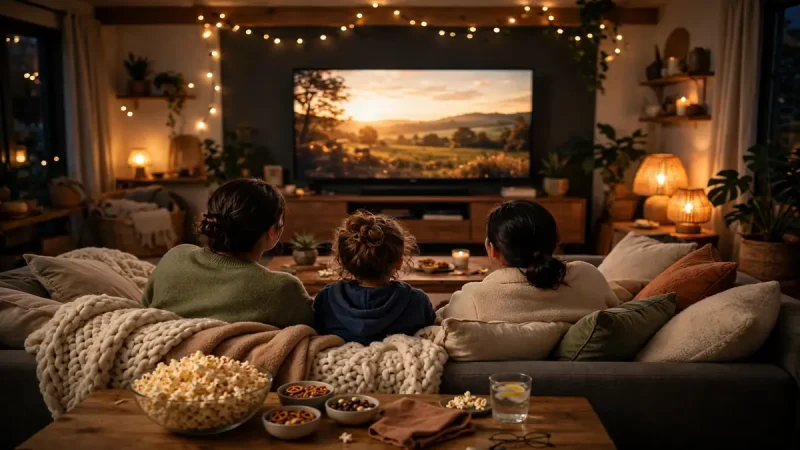
Lighting changes everything, and it is free. Switch off the bright overhead lights before the film starts. Use a lamp in the corner, a string of warm fairy lights, or a single candle in a safe spot away from the seating. Soft, warm light makes the room feel like a theater, while bright white light makes it feel like an office.
Close the curtains if the sun is still up. Cover any small glowing lights on chargers or devices near the screen, since even a tiny bright dot can distract the eye. Once the film begins, turn the remaining lights down or off. The darker the room, the bigger the screen feels, and the easier it is to forget you are at home at all.
Picture and Sound: Test Before You Press Play
Nothing kills the mood faster than a film that starts with no sound or a picture that keeps buffering. Test everything while the room is still empty. Play the first minute of the film, check that the sound is clear, and set the volume to a level that works for the back row as well as the front.
If your television speakers sound thin, a simple soundbar helps, but it is not required. Even moving the television a little closer to the seating, or turning off a noisy fan, can improve the sound more than you might expect. Make sure the film is fully loaded or downloaded before the start time, especially if your internet connection is slow in the evening.
Finally, check the seating distance. If everyone is too close, the picture feels overwhelming. Too far away, and the details get lost. A good rule is to sit back far enough to see the whole screen without moving your eyes from side to side. Then you are ready for the food.
Snacks That Work in the Dark
Half the fun of a movie night is the food, but not every snack belongs in a dark room. The best movie snacks share three qualities: they are easy to grab without looking, they do not need a knife and fork, and they do not make a mess on the sofa. Popcorn is the classic for a reason. It ticks all three boxes, and a big bowl in the middle of the room keeps everyone happy.
Build your snack table around a simple mix of salty, sweet, and something warm. Salty snacks wake up the taste buds. Sweet snacks feel like a treat. Something warm, like pizza slices or soft pretzels, turns a casual night into a small occasion. Put the snacks within easy reach of the seats, in bowls rather than packets, so nobody has to rustle through packaging during a quiet scene.
If you want a homemade sweet that feels special without taking hours, try this chocolate-dipped pretzels recipe. The salty-sweet mix is perfect for a film, and you can make a batch earlier in the day. They keep well, they look great in a bowl, and they disappear fast, so make more than you think you need.
| Snack Type | Easy Ideas | Why It Works |
|---|---|---|
| Salty | Popcorn, pretzels, chips, snack mix | Easy to share, no cutlery, keeps hands busy |
| Sweet | Cookies, candy, brownies, fruit | Feels like a treat and suits a cinema mood |
| Warm | Pizza slices, sliders, nachos, soft pretzels | Turns the night into a small occasion |
| Drinks | Water, juice, fizzy drinks, hot chocolate | A drink station stops trips to the kitchen |
Keep Drinks and Cleanup Simple
Set up a small drink station away from the main seats, with cups, ice, and a few choices. When people can help themselves, you do not spend the film playing waiter. Keep a few napkins nearby, and keep the food simple enough that you can clean up in a few minutes when the credits roll.
Themes That Turn a Film Into an Event
A theme is the easiest way to make an ordinary movie night feel memorable. You do not need decorations from a party shop. A theme is really just a simple idea that ties the film, the food, and the mood together. Pick one detail to match the film, and the rest falls into place.
For example, a beach film pairs well with light snacks and bright cushions, while a mystery film works with dim lighting and a bowl of dark chocolate. A film set in another country is a good excuse to try a snack from that place, and a childhood classic calls for the comfort food you grew up with. The theme does not need to be perfect. It only needs to be fun.
| Theme Idea | Film to Match | One Simple Touch |
|---|---|---|
| Comfort rewatch | A favourite comedy or childhood classic | Blankets, pyjamas, and hot chocolate |
| A little spooky | A mystery or light horror film | Dim lights and a bowl of candy |
| Around the world | A film set in another country | One snack from that place |
| Throwback night | A film from another decade | A playlist from the same decade |
| Outdoor screening | A nature or adventure film | Blankets on the floor and fairy lights |
Another easy idea is a homemade ticket for each guest before the film starts. Write the film name, the start time, and one fun line on a small card. Kids love this, and adults smile at it too. It costs nothing, takes five minutes, and tells everyone that tonight is not just another evening in front of the television.
Movie Night for Different Crowds
The same basic plan works for everyone, but a few small changes make each kind of night much better. The group in the room decides the details, so let the group shape the night.
With Kids: Keep It Short and Simple
For a family movie night, shorter is better. A film that runs too long will lose younger kids, no matter how good it is. Pick something the youngest viewer can follow, start early enough that the ending does not run past bedtime, and keep the snacks simple. A blanket fort on the floor often beats the sofa, and a bowl of popcorn each keeps the peace better than one shared bowl.
It also helps to think about the rest of the evening, not just the film. A movie night is still screen time, even when it is a family event, so keep it as a special occasion rather than a daily habit. If you want a few practical ideas for balance, this guide on how to reduce screen time for kids explains how to set simple family rules that work without turning every evening into a negotiation.
When the film ends, help the kids wind down instead of sending them straight to bed. A short chat about the best scene, a drink of water, and a calm few minutes make the change from an exciting film to sleep much easier. A simple bedtime routine for kids works well here too, since the same steps that calm a school night also calm a movie night.
With Friends: Let Everyone Bring Something
With friends, the film is only part of the night. Ask each person to bring one snack or drink. It spreads the cost, it spreads the effort, and it gives everyone a small part in the evening. One person brings popcorn, another brings drinks, and someone else brings dessert. Suddenly the host is not doing everything, and the night feels shared.
Friends also enjoy a little friendly competition before or after the film. A quick quiz about the film, a guess-the-quote game, or a vote for the best scene keeps the energy up after the credits. Keep it light and short. The goal is laughter, not a test.
For Two, or on Your Own: Slow Down
A movie night for two, or for one, is a chance to slow down properly. You do not need a big spread or a theme. Pick a film you have both been meaning to watch, make one good snack, dim the lights, and put the phones in another room. The quiet is the point.
On your own, a movie night can be a small weekly ritual. Choose a film on Sunday, cook something you enjoy, and give yourself two hours with no chores and no scrolling. It sounds small, and it is, but a regular evening like this can become one of the best parts of the week.
After the Credits: Keep the Night Going
The film does not have to end when the credits start. A few minutes of conversation can be the best part of the night. Ask everyone for their favourite scene, or the one moment that surprised them. Ask what they would change about the ending. You will be amazed how different the same film looked to different people in the same room.
If your group enjoys quizzes, a short round of trivia after the film works brilliantly. Try this CNN quiz as a warm-up, or make up a few questions about the film you just watched. Keep the round to five or six questions, and keep score only if your group enjoys that kind of thing.
Some groups like to follow a film with a game instead. Video games lead the entertainment industry for a reason: they give people of all ages something to do together after the screen goes quiet. A short cooperative game, where everyone plays on the same side, keeps the friendly mood going without turning the night into a competition.
When Things Go Wrong
Even a good plan meets a problem sometimes. The film buffers, the sound cuts out, or someone arrives late. Most fixes take a minute, so do not let a small problem spoil the night.
- The film will not load. Check your connection, restart the app, and have a backup film ready on a different service.
- The sound is too quiet. Turn the volume up slowly, move closer to the speakers, and switch off anything noisy in the room.
- Someone arrives late. Start on time anyway, and give latecomers a quick whispered summary at the next natural pause.
- The kids lose interest. Take a short break, stretch, refill the snacks, and see if the film picks up again. If it does not, switch to something shorter.
- People keep checking phones. Put all the phones in a basket by the door, and make it a fun rule instead of a lecture.
- You run out of snacks. Laugh about it, share what is left, and remember it for next time. Nobody remembers a missing snack, but everyone remembers a relaxed host.
The real secret of a good host is not a perfect night. It is a calm reaction when something goes wrong. If you stay relaxed, your guests stay relaxed too, and the night is still a success.
Make It a Weekly Thing
The best movie nights are not one-off events. They are a small tradition, and traditions are easier to keep than you might think. Pick a regular night, such as Friday or Saturday, and protect it. Keep the plan simple enough to repeat without a big effort, and let the group take turns choosing the film and bringing the snacks.
A weekly movie night gives everyone something to look forward to, and it gets easier each time. You learn which snacks disappear fastest, which seats people prefer, and which films your group enjoys most. After a few weeks, the setup takes minutes, because everyone knows their part.
Start small. One film, one bowl of popcorn, one evening a week. That is all it takes. The tradition will grow on its own, and in a few months you will wonder why you did not start sooner.
Frequently Asked Questions
What do I need for a movie night at home?
You need a screen, a comfortable place to sit, something to eat, and a film everyone agrees on. That is the whole list. Blankets, dim lighting, and a drink station make the night better, but none of them are required. Start with the basics, and add one small extra each time until the night feels like yours.
How do I choose a movie everyone will enjoy?
Send two or three options to your group before the night and let them vote. Match the film to the people in the room, the time you have, and the mood of the evening. A short, light film suits a school night, while a longer film suits a relaxed weekend. When in doubt, pick the film everyone is curious about.
What snacks are best for a movie night?
Choose snacks that are easy to grab in the dark and do not need cutlery. Popcorn, pretzels, chips, cookies, and fruit all work well. Add one warm option, such as pizza slices or nachos, if you want the night to feel special. Put the food in bowls within reach of the seats, and set up a simple drink station so nobody has to leave the room.
How can I make a movie night feel special without spending much?
Dim the lights, pile up the blankets, and add one small themed touch that matches the film. A playlist from the film’s decade, a snack from the country where the film is set, or homemade tickets for each guest all cost almost nothing. The feeling of a special night comes from the small details and the shared time, not from what you spend.
Your Next Movie Night Starts With One Decision
Planning a movie night at home does not need a big budget, a home theater, or a perfect plan. It needs one decision made early: the film. Once that is settled, the rest follows naturally. Clear the seats, dim the lights, put out the snacks, and press play.
So pick a night this week, send your group three options, and let them vote. Lay out the blankets, make the popcorn, and silence the phones. You now know how to plan a movie night at home without spending much or buying new gear. Your living room is already a cinema. All it needed was a plan, and now you have one.

