
You know you should drink more water. Everyone does. And yet, by the end of most days, the glass on your desk is still half full, the bottle in your bag is untouched, and you cannot remember the last time you actually drank a full glass of water. If that sounds familiar, you are in good company — and the fix is much simpler than you think.
Learning how to drink more water every day is not about willpower. It is definitely not about forcing yourself to carry a giant jug everywhere you go. It is about building small, easy habits into a day you already live. Then drinking water happens almost by itself. This guide explains why water matters, how much you actually need, and 12 simple habits that help you drink more water every day — habits that fit real life, with work, family, and days that do not go to plan.
Why Drinking Enough Water Matters
Water is involved in almost everything your body does. It carries nutrients to your cells and helps regulate your body temperature. It also cushions your joints, supports digestion, and helps your kidneys clear out waste. Even mild dehydration — the kind you get from simply forgetting to drink — can leave you feeling tired, foggy and headachy, and it can make it harder to concentrate.
Most of us notice the effects before we notice the cause. That afternoon slump where you cannot think straight? The headache that arrives around 4pm? The dry mouth and the feeling of being oddly tired even though you slept well? Sometimes the answer is not more coffee. Sometimes it is a glass of water.
Water also plays a quiet supporting role in almost every other healthy habit you already care about. It helps your body recover after exercise, and it supports your skin. It also helps you tell the difference between hunger and thirst. That matters more than people realise, because the two signals feel surprisingly similar. If you are already working on your health, water is the easiest win on the list. Our guide to fitness and nutrition tips covers the bigger picture, but hydration is the foundation underneath all of it.
How Much Water Do You Actually Need?
The advice most people know is “eight glasses a day.” It is a useful starting point, but it is not a rule. Your real needs depend on your body size, how active you are, the weather, and what you eat. A widely cited general guideline from the US National Academies puts total daily water intake at roughly 2.7 litres (about 91 ounces) for adult women and 3.7 litres (about 125 ounces) for adult men. That figure covers all food and drink combined. That sounds like a lot. Remember, though, that around a fifth of it usually comes from food, especially fruit, vegetables and soups.
Rather than counting millilitres obsessively, most health professionals suggest two simple checks. First, thirst: it is a reliable signal for most healthy adults. It can lag behind your actual needs during intense exercise, and it tends to become less sharp as you get older. Second, the colour of your urine: pale yellow, like lemonade, generally suggests you are drinking enough. Dark amber suggests you need more. Clear every time is not the goal either — it can mean you are drinking more than you need.
There is one more thing worth saying plainly: you do not need to hit a perfect number every single day. Some days you will drink more, some days less, and that is fine. The goal is a steady, comfortable habit, not a score to chase.
How to Drink More Water Every Day: 12 Simple Habits
Here are 12 habits that actually work, in roughly the order you would use them through a normal day. You do not need all 12. Pick three or four that fit your life, try them for a week, and add more only if you want to.
1. Start with a glass of water when you wake up
This is the single easiest habit on the list. You have just spent seven or eight hours without drinking anything, so a glass of water first thing in the morning genuinely helps you rehydrate. Put a glass or bottle by your bed the night before, or make it the first thing you do when you reach the kitchen. Pairing it with something you already do makes it stick. For example, drink your water while your morning coffee brews, or right after your morning stretching routine. One glass, done before the day has even started.
2. Carry a water bottle with you
People drink more water when water is within arm’s reach. It really is that simple. Choose a bottle you actually like — one that fits your bag, does not leak, and feels nice to drink from. Some people swear by bottles with a straw. Sipping through a straw feels effortless, so you drink more without thinking about it. A bottle with time markings can help some people, but if markings feel like a chore, ignore them. The bottle itself is the habit; everything else is optional.
3. Anchor water to things you already do
This technique, sometimes called habit stacking, is one of the most reliable ways to build any new habit. Attach a glass of water to something you already do without fail. Try a glass when you brush your teeth, a glass before each meal, a glass when you take your medication, or a glass when you sit down at your desk. Each anchor turns a vague intention (“I should drink more water”) into a specific moment with a clear trigger. If you want to understand why this works so well, our guide on how to stay consistent with new habits explains the psychology behind it. Small habits attached to existing routines are far more likely to survive than habits that depend on remembering.
4. Drink a glass before every meal
Three meals a day means three guaranteed glasses of water, without any extra planning. A glass of water about half an hour before eating has a bonus benefit if you are watching your weight. It helps you feel a little fuller before you start, which makes it easier to eat mindfully rather than rushing. Keep a jug or a glass on the dining table so the water is there when you sit down, not something you have to go and fetch.
5. Make water visible
Out of sight really does mean out of mind. A bottle on your desk, a glass by the kitchen sink, a bottle in the car cup holder — every visible cue is a quiet reminder to take a sip. This is especially useful at work, where hours can pass without you leaving your chair. If you spend most of your day at a desk, put the bottle right next to your keyboard, not on a shelf across the room. While you are at it, it is worth checking your desk setup generally. Our guide on how to improve your posture while sitting at a desk will help your back and neck survive those long sitting days too.
6. Flavour your water if plain water bores you
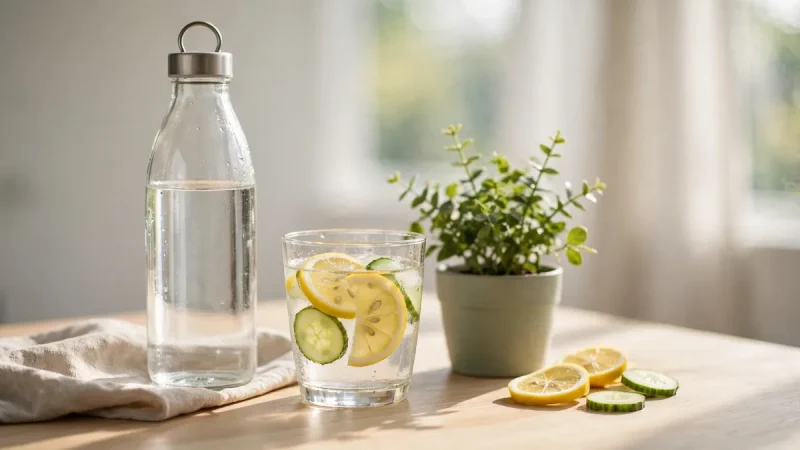
Let us be honest: some people find plain water boring. There is no prize for forcing yourself to drink something you dislike. Slices of lemon, cucumber, orange or mint can make water taste like something you actually want. So can a handful of berries, or a splash of fruit juice. Sparkling water counts too, and it is a good swap if you are trying to cut back on fizzy drinks. Just go easy on the sugar — sweetened drinks are not a good hydration foundation, even if they contain water.
7. Eat your water
A surprising amount of your daily fluid comes from food. Watermelon is about 92% water, and cucumber, lettuce, celery, oranges, strawberries and soups all contribute. A diet rich in fruit and vegetables hydrates you far better than a diet of dry, processed food. This is another reason a bit of planning helps. When you sit down to plan your week, our guide to meal prep for beginners shows how to build a simple weekly system that makes water-rich foods a normal part of your meals rather than an afterthought.
8. Set gentle reminders
A phone alarm that goes off every hour with a simple “time to drink” message works well for a lot of people. It helps especially if your job keeps you focused on a screen for hours at a time. You can also use calendar reminders, a smartwatch nudge, or a sticky note on your monitor. The point is not to be scolded into drinking — it is to break the spell of a busy day. After a week or two, you may find you do not need the reminders any more, because the habit has started to run itself.
9. Replace one drink a day with water
You do not need to give up coffee, tea or the occasional fizzy drink. Just swap one of them for water. If you normally have three coffees, make the middle one a glass of water. If you reach for a sugary drink with lunch, have water instead and save the sweet drink for a treat. One swap a day adds up to seven extra glasses a week. It often changes your taste over time, too — many people find they start to prefer water once they get used to it. And remember: moderate amounts of coffee and tea do count towards your daily fluid intake, so you do not need to feel guilty about them.
10. Drink more when you move more
Exercise, hot weather and even a long walk all increase how much water you lose through sweat. So they should also increase how much you drink. A practical rule is to drink a glass before you start, sip during longer sessions, and drink again afterwards. This pairs naturally with any walking or exercise habit — if you are following our walking routine for beginners, a bottle in your hand or in your bag turns every walk into a hydration opportunity as well.
11. Slow down in the evening and have a final glass
A glass of water in the early evening, as part of winding down, is a calm way to top up your day. Try not to drink a large amount right before bed, though, because it can mean waking up in the night. Think of your evening glass as the last chapter of the day rather than a race to hit a target. It fits neatly into a wider wind-down routine. If you want help building one, our sleep hygiene checklist covers the full evening routine, from screens to bedroom temperature.
12. Track it simply — or not at all
Some people love tracking: an app, a tick on a piece of paper, or a bottle with markings. If tracking motivates you, use it. Skip it if it feels like homework. The two simple checks from earlier — thirst and pale yellow urine — are enough for most people. The best tracking system is the one you will actually use, and for many people that means no tracking at all, just a bottle that is always nearby and always being refilled.
What Counts as Water?
Not every drink hydrates you equally, but more drinks count than people think. Plain water is the best choice. Sparkling water, herbal tea, milk, and even moderate amounts of coffee and tea all contribute to your daily fluid intake, too. The old idea that caffeine automatically dehydrates you has been revised — moderate caffeine does not cancel out the fluid in the drink.
What does not count well is alcohol, which makes your body lose fluid. Very sugary drinks also count poorly: they bring a lot of calories and can leave you feeling less refreshed than water would. That does not mean you can never have them. It just means they should not be the foundation of your hydration. Think of water as the default and everything else as the extras.
Food counts too, as we covered above. A bowl of soup, a piece of fruit, a salad — all of it adds up. If you eat well, you are already part of the way there before you pick up a glass.
Signs You Might Not Be Drinking Enough
Your body gives you plenty of clues when it needs more fluid. The most obvious is thirst, but by the time you feel properly thirsty you are often already slightly dehydrated, so it helps to know the earlier signs too.
Watch for a dry mouth or dry lips, a headache that creeps in during the afternoon, and feeling unusually tired or finding it hard to concentrate. Also watch for darker urine than usual, and skin that feels dry. Constipation can also be a sign, since water helps keep digestion moving. None of these signs on their own proves dehydration, as headaches and tiredness have many causes. But if several of them show up together on a day when you have barely drunk anything, water is a sensible first step before reaching for anything else.
If you ever feel dizzy, confused, or notice that you have stopped sweating or urinating, seek medical advice promptly. Those can be signs of more serious dehydration, and they are not something to handle with a glass of water alone.
Common Mistakes That Undo Good Intentions
Drinking it all at once. Gulping a litre of water in one go after ignoring thirst all day does not work as well as sipping steadily. Your body can only use so much at once, and the rest just passes through. Small, regular sips are the goal.
Waiting until you are thirsty. Thirst is a late signal, not an early one. If you only drink when you feel thirsty, you spend much of the day slightly behind. The anchor habits in this guide exist to solve exactly this problem.
Replacing water with sugary drinks. A fizzy drink or a sweetened juice might feel refreshing for a few minutes, but it does not hydrate you as well as water, and it adds calories you probably do not need. Keep sweet drinks as a treat, not a habit.
Forgetting that food, weather and exercise change your needs. A hot day, a long walk, a workout, or a salty meal all raise your fluid needs. A fixed target that never changes with your day is not a good target — listen to your body and adjust.
Trying to change everything on day one. Buying a two-litre bottle, downloading three apps and setting ten alarms is a recipe for giving up by Wednesday. Start with one or two habits from this list, let them settle, and build from there. Hydration is a gentle, long-term habit. It works best when it fits into your life rather than fighting against it. Treating it as part of your wider wellbeing helps it stick. It becomes something you do for yourself, the same way you might approach a self-care routine, rather than another rule to follow.
A Simple 7-Day Plan to Drink More Water
If you like a plan to follow, here is one week that builds the habit step by step without overwhelming you.
Day 1: Put a glass of water by your bed tonight, and drink it when you wake up tomorrow. That is the whole task for day one.
Second day: Add a bottle to your bag or desk. Keep it visible and within reach all day, and refill it whenever it is empty.
Third day: Add the before-meals habit: one glass of water before breakfast, lunch and dinner.
Fourth day: Try flavouring your water — lemon, cucumber or mint — and see if it makes drinking more enjoyable.
Fifth day: Add one water-rich food to a meal, such as a salad, a piece of watermelon, or a bowl of soup.
Sixth day: Swap one sugary or caffeinated drink for water, and set a single hourly reminder if your days tend to run away from you.
Seventh day: Look back at the week. Keep the habits that felt easy, and drop the ones that felt like a chore. You now have a hydration routine that fits your actual life, not someone else’s.
Frequently Asked Questions
Can you drink too much water?
It is rare in healthy adults, but yes, it can happen. It usually involves drinking very large amounts in a very short time — far more than the habits in this guide involve. If you drink steadily through the day and pay attention to thirst, over-drinking is not something most people need to worry about. Ask your doctor what is right for you if you have a kidney condition or take medication that affects fluid balance.
Does coffee count towards my daily water intake?
Moderate amounts of coffee and tea contribute to your fluid intake, because the water in them counts. The old advice that coffee dehydrates you has been largely revised. That said, water is still the better default choice, especially if you drink several coffees a day.
Is sparkling water as good as still water?
For hydration, yes — sparkling water hydrates you just as well as still water. The main difference is the fizz, which some people find makes them feel full, and the fact that flavoured sparkling waters sometimes contain sugar or sweeteners, so it is worth checking the label.
How can I remember to drink water at work?
Keep a bottle on your desk where you can see it, tie drinking to things you already do — a glass when you sit down, a glass after each meeting, a glass before lunch — and set one hourly reminder if you need it. Visible water and small anchors beat willpower every time.
What is the best water bottle for staying hydrated?
The best one is the one you will actually carry and use. A reusable bottle that fits your bag, does not leak, and is easy to drink from — ideally with a straw if you like sipping — will do more for your hydration than any expensive smart bottle. Choose one you like the look of, because you are more likely to keep it with you.
Final Thoughts
Drinking more water does not need a new personality, a strict schedule or a special product. It needs a glass by your bed, a bottle on your desk, and a few small habits attached to things you already do. Start with the morning glass. Add a bottle. Drink before meals. That is most of the job done, and it takes almost no effort once the habits settle in.
Your body will notice the difference before you do — a little more energy in the afternoon, fewer headaches, clearer thinking. And because the habits are small, they are the kind that last. Pick three from this guide, try them for a week, and see how you feel. Chances are, you will wonder why you did not start sooner.