
The Definitive Solution: Who is the Peter Pan Dog?
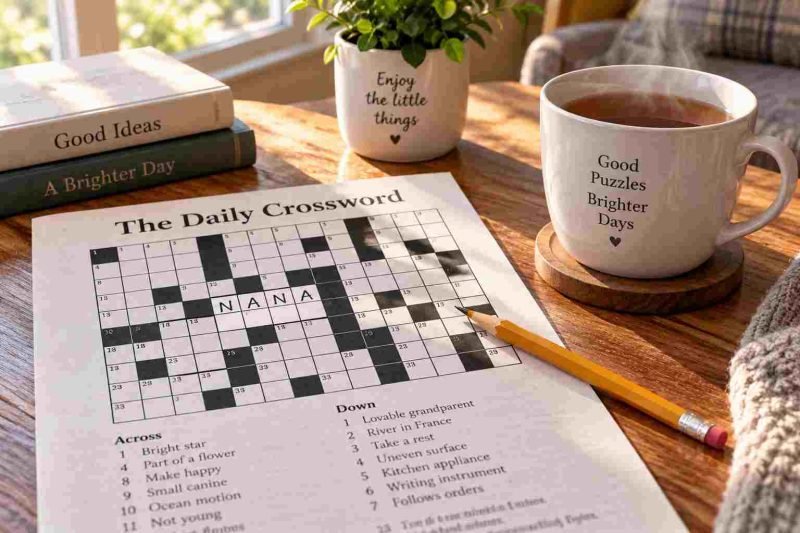
When you encounter the clue “Peter Pan dog” in a crossword puzzle, the definitive four-letter answer is almost always NANA. Occasionally, clue writers phrase the prompt as “Darling family pooch” or “Barrie nursemaid dog.” Regardless of the exact phrasing, the answer remains NANA. This faithful Newfoundland canine serves as the nursery caretaker for the Darling children in J.M. Barrie’s classic play and novel.
Crossword puzzle editors love the name NANA for several distinct construction reasons. First, the word consists of four short letters that fit easily into tight grid intersections. Second, it features an alternating pattern of common consonants and vowels. Specifically, the letter combination N-A-N-A provides flexible crossing possibilities for adjacent down and across words. Consequently, NANA has appeared thousands of times across the New York Times, USA Today, Wall Street Journal, and Los Angeles Times crosswords.
In addition, maintaining mental discipline in word games mirrors broader strategic development models. For example, organizational planning frameworks detailed in scaling business services growth highlight the necessity of structured problem-solving. Similarly, analytical research in small business growth and marketing analysis demonstrates that pattern recognition builds long-term commercial success. Solvers apply these exact analytical principles whenever they tackle challenging crossword grids.
The Literary History of Nana in J.M. Barrie’s Peter Pan
To appreciate why Nana appears so frequently in popular culture, one must understand her literary origins. Scottish playwright J.M. Barrie first introduced Peter Pan in the 1904 stage play *Peter Pan, or The Boy Who Wouldn’t Grow Up*. Afterward, Barrie expanded the narrative into the 1911 novel *Peter and Wendy*. Within the story, the Darling family lives in Bloomsbury, London.
Because the Darling parents are financially conscious, they cannot afford an expensive human nursemaid for Wendy, John, and Michael. Instead, they hire a prim, remarkably intelligent dog named Nana. Specifically, Barrie describes Nana as a majestic Newfoundland dog who takes her childcare duties very seriously. For instance, she escorts the children to school, turns down their beds, prepares warm bathwater, and administers cod-liver oil medicine without spilling a single drop.
| Clue Variation | Standard Letter Count | Correct Solution | Underlying Literary Context |
|---|---|---|---|
| Peter Pan dog | 4 Letters | NANA | The Darling family’s nursemaid canine in J.M. Barrie’s story |
| Darling dog of literature | 4 Letters | NANA | A clever pun referencing both the Darling family and canine charm |
| Barrie’s nursery pooch | 4 Letters | NANA | Direct attribution to author J.M. Barrie |
| Wendy’s canine caretaker | 4 Letters | NANA | Reference to Wendy Darling, the eldest sibling |
The Real-Life Inspiration Behind Nana
Interestingly, J.M. Barrie based Nana on his real-life pet dog, a Landseer Newfoundland named Luath. Barrie frequently walked Luath through London’s Kensington Gardens, where he first met the Llewelyn Davies boys who inspired Peter Pan. In fact, the playwright observed the dog’s patient, protective nature around children. Furthermore, Barrie previously owned a Saint Bernard named Porthos. Consequently, theatrical productions and animated adaptations sometimes depict Nana as either a Newfoundland or a Saint Bernard.
Nana’s Pivotal Role in the Peter Pan Plot
Nana is not merely decorative background scenery in the narrative. In fact, her actions trigger the central adventure. Specifically, Mr. Darling feels embarrassed that his neighbors might see a dog acting as a family nanny. Following an argument over medicine, Mr. Darling chains Nana outside in the courtyard. Because Nana is chained away from the nursery, Peter Pan and Tinker Bell are able to enter through the window. Therefore, Nana’s temporary absence allows the children to fly away to Neverland.
Why “NANA” is Crosswordese Royalty
In the world of puzzle construction, experienced constructors refer to frequently repeated short words as “crosswordese.” In fact, certain words appear constantly because they contain common letters that connect difficult sections of a grid. Consequently, NANA is considered absolute royalty in this category.
Several linguistic factors explain why crossword creators use this word so often:
- High Vowel-to-Consonant Ratio: The letter ‘A’ is the third most common letter in the English language, making it extremely valuable for grid intersections.
- Flexible Cluing Potential: Constructors can clue NANA as a family nickname, a grandmother term of endearment, a famous 1880 Émile Zola novel, or the Peter Pan dog.
- Symmetrical Letter Repetition: The repeating N-A sequence allows constructors to place it cleanly along corner borders and tight puzzle corners.
- Familiarity for Solvers: The clue provides a reliable entry point that rewards cultural knowledge without frustrating the solver.
Therefore, whenever you see a four-letter clue asking for a canine nursemaid, grandmother, or literary pet, write down NANA immediately with confidence.
The Cognitive and Brain Health Benefits of Crossword Puzzles
Solving crossword puzzles provides far more than brief entertainment on a Sunday morning. In fact, scientific studies confirm that regular puzzle-solving stimulates neuroplasticity, preserves cognitive reserves, and enhances verbal fluency. Moreover, engaging in deliberate mental problem-solving keeps neural pathways active throughout adult life.
Specifically, daily word puzzles deliver distinct cognitive advantages:
- Memory Recall Enhancement: Searching your mental database for historical facts, literary names, and synonyms strengthens associative memory networks.
- Dopamine-Driven Focus: Filling in a correct answer triggers a micro-release of dopamine in the brain, reinforcing motivation and concentration.
- Stress Reduction and Mindfulness: Focusing on a challenging crossword grid shifts attention away from daily anxieties, inducing a state of calm mental flow.
- Vocabulary Expansion: Encountering unfamiliar terms, archaic definitions, and clever puns broadens your working linguistic knowledge.
Consequently, dedicated solvers protect their mental sharpness while enjoying a satisfying intellectual diversion.
Commercial Publishing, Digital Apps, and Crossword Infrastructure
Behind the daily delivery of crosswords lies an expansive publishing industry. Specifically, major newspapers, independent syndicates, and digital game developers invest heavily in puzzle creation, editing, and software platforms. Furthermore, modern puzzle apps require robust server architectures to support millions of daily global players simultaneously.
Media developers and game publishers frequently manage technology assets through structured commercial financing options. For instance, digital media companies evaluate asset funding programs like Northmill equipment finance to secure high-performance computing hardware while preserving operating liquidity. In addition, growing gaming studios utilize commercial credit lines such as Navitas financial solutions to fund software development. Commercial real estate investors also analyze institutional development debt models detailed in Lument real estate capital investments. Meanwhile, distinctive digital game branding draws inspiration from creative design principles in Flowfury Entertainment logo strategies.
Holistic Lifestyle Balance, Physical Movement, and Mental Vitality
Enjoying sedentary intellectual pastimes like crosswords is most beneficial when paired with an active physical lifestyle. Specifically, the brain requires abundant oxygenated blood flow, healthy nutrition, and restorative rest to maintain peak analytical performance throughout the day. Neglecting physical movement leads to brain fog and cognitive fatigue.
Moreover, committing to daily physical activity provides lasting health benefits, aligning with routines like exercising 40 minutes every day in natural settings. In addition, enjoying an early evening meal supports healthy digestion and restful sleep, reflecting principles discussed in benefits of early dinner for digestion. Many puzzle enthusiasts also create relaxing home study spaces inspired by the nature-focused lifestyle principles of balanced lifestyle luxury and wellness.
Furthermore, maintaining overall personal wellness involves regular consultations with trusted healthcare providers. Respected regional healthcare networks, including community clinics like the Muskingum Valley Health Center and public health systems like the Gastonia Health Department, emphasize preventive cognitive health and lifestyle balance. Meanwhile, independent publishing brands expanding their online audience can evaluate targeted promotional frameworks through advertising marketing growth in Los Angeles.
Essential Strategies to Solve Tricky Crossword Clues
Becoming an expert crossword solver does not require an encyclopedic memory of obscure trivia. Instead, successful solvers rely on strategic decoding techniques that decipher the constructor’s intended meaning. Consequently, understanding puzzle conventions transforms seemingly impossible clues into solvable riddles.
To improve your crossword-solving accuracy, apply these proven techniques:
Match the Tense, Plurality, and Part of Speech
A crossword clue always matches the grammatical form of its answer. For example, if a clue is written in the past tense, the solution must also be past tense. Similarly, if the prompt asks for a plural noun, the answer will end in a plural form, usually with the letter ‘S’.
Look for Punctuation Clues and Question Marks
Furthermore, when a crossword clue ends with a question mark, the constructor is signaling wordplay, a pun, or a figurative twist. Do not interpret the clue literally. For example, “Child’s caretaker?” might humorously lead to NANA rather than a professional governess.
Fill in the Short Fill First
Specifically, three-letter and four-letter answers form the structural backbone of any crossword grid. Therefore, scanning the puzzle for short, familiar words gives you vital starting letters for longer intersecting entries. Answers like NANA, OREO, ALOE, and AREA provide immediate traction across the grid.
Leverage Crossing Letters Before Guessing
In addition, if you are unsure of a longer answer, never guess blindly. Instead, solve the intersecting down or across clues first. Consequently, revealing even two crossing vowels often triggers immediate recognition of the target word.
Step-by-Step Guide: How to Solve Daily Crossword Puzzles Faster
Improving your puzzle completion speed requires a systematic approach. Follow this structured roadmap to boost your solving confidence and solve daily grids with ease:
- Complete the First-Pass Scan: First, read through all the across clues quickly, filling in only the answers you know with absolute certainty.
- Execute the Down-Clue Pass: Second, scan through the down clues to verify your initial entries and capture immediate crossing words.
- Target Familiar Pop Culture and Literature: Third, look for recurring literary references, such as the Peter Pan dog, Greek gods, and classic author names.
- Focus on Corner Clusters: Fourth, tackle dense corner sections where short four-letter entries intersect, unlocking stubborn grid corners.
- Reread Long Theme Entries: Fifth, inspect the longest answers on the grid, as they usually reveal the overarching theme of the daily puzzle.
- Double-Check Crossing Letters: Finally, review any uncertain spellings by checking the intersecting perpendicular words before concluding your solve.
Following this disciplined process ensures that you progress steadily through the grid without unnecessary frustration.
Frequently Asked Questions About the Peter Pan Dog Crossword Clue
What is the 4-letter answer for the Peter Pan dog crossword clue?
The standard four-letter answer is NANA, named after the Darling family’s faithful Newfoundland nursemaid dog in J.M. Barrie’s story.
What breed of dog was Nana in the original Peter Pan story?
In the original novel and stage play by J.M. Barrie, Nana is a Newfoundland dog, inspired by Barrie’s real-life Landseer Newfoundland named Luath.
Why does NANA appear so frequently in crossword puzzles?
NANA appears often because it features an alternating pattern of common consonants and vowels, allowing constructors to connect words easily in tight grid sections.
What are other common crossword clues that lead to NANA?
For instance, other common clues include “Grandmother, affectionately,” “Darling family caretaker,” “1880 Zola novel,” and “Family term of endearment.”
Conclusion: Celebrate the Joy of Wordplay and Literary Mystery
Solving crosswords is an enduring celebration of human language, literature, and intellectual curiosity. Clues like the Peter Pan dog connect modern puzzle enthusiasts with timeless classic stories, proving that great literature lives on in our daily pastimes. In fact, Nana remains an unforgettable literary character whose name brings delight to crossword grids worldwide.
Whether you are solving your first Monday puzzle or tackling a challenging Sunday grid, recognizing classic answers like NANA sharpens your skills and builds puzzle-solving momentum. Therefore, keep your pencil sharpened, embrace the challenge, and enjoy every exciting crossword journey today!