
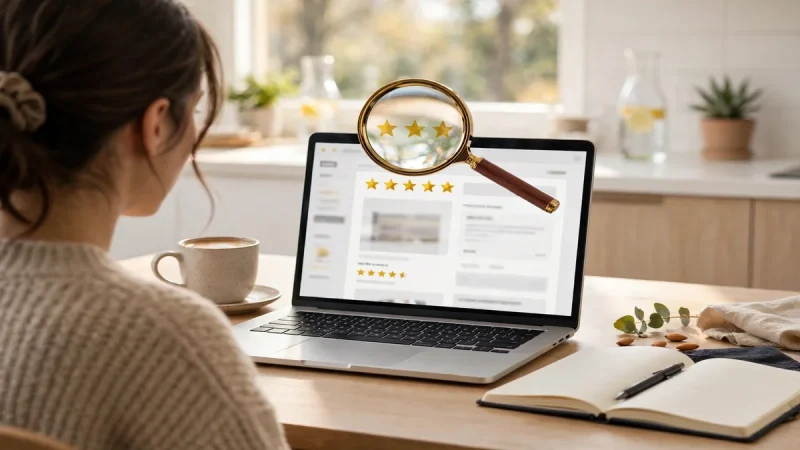

How to Spot Fake Product Reviews Before You Buy Anything Online
You find a product that looks perfect. It has 4.9 stars, hundreds of glowing reviews, and a price that feels like a bargain. You click buy, the parcel arrives, and the product falls apart within a week. Sound familiar?
Reviews should help you choose well. Yet a growing share of them comes from people who never used the product, from sellers who paid for praise, or from software that writes praise on demand. The good news is that you can learn how to spot fake product reviews in about a minute, and the checks are simple once you know what to look for.
This guide walks you through the red flags, a quick 60-second routine, and the free tools that help you separate honest feedback from noise. You will shop with more confidence after reading it, and you will waste less money on products that never deserved five stars.
Why Fake Reviews Work So Well
Reviews work because they borrow trust. When you cannot touch a product or visit a shop, other buyers stand in for your own eyes and hands. A row of five-star ratings feels like a crowd of happy customers telling you the product is safe to buy.
Fake reviews exploit that shortcut. Google says it blocked or removed more than 292 million policy-violating reviews on Maps in 2025, which shows the scale of the problem. Marketplaces, review sites and search engines all filter bad reviews, yet plenty still slip through.
Sellers use fake reviews because they pay off. A product with a high rating sells more, ranks higher in search results, and attracts real buyers who then leave real reviews. The fake ones do the early work, and the honest ones arrive later. That is why even a product with thousands of reviews can still mislead you.
The trick is not to stop trusting reviews. The trick is to read them like a detective reads a witness statement: look for detail, consistency and motive, and never let the star rating do all the thinking for you.
Red Flag 1: The Language Sounds Too Good to Be True
Real customers write like real people. They mention a detail, a small annoyance, or a specific situation. Fake reviews often sound like adverts instead.
Watch for vague praise that could fit any product. Phrases such as “best product ever”, “absolutely amazing” and “life-changing” tell you nothing about what the product actually does. A genuine buyer is more likely to write something concrete, like “the battery lasted through a full weekend camping trip” or “the zip broke after three weeks of daily use”.
Also watch for the full product name repeated again and again. A real customer rarely writes “the AquaPure X5 Water Filter changed my life, and the AquaPure X5 Water Filter is the best filter I have ever owned”. That pattern usually points to someone who wants search engines to rank the product name, not to a happy customer.
Extreme emotion is another warning sign. Reviews that swing between furious and ecstatic often come from competitors or paid writers. Most honest reviews sit in the middle: pleased but honest about a flaw, or disappointed but fair about what worked.
Red Flag 2: Too Many Reviews, All at Once
Timing tells a story that words cannot hide. A genuine product gathers reviews slowly, with a mix of good and bad, over weeks and months. A fake campaign arrives in a burst.
Open the review list and sort it by “most recent”. If you see dozens of five-star reviews landing within a day or two, after weeks of silence, treat that burst with suspicion. New products rarely earn hundreds of perfect ratings in their first week. That pattern usually means someone paid for a batch of reviews or ran a promotion that rewarded them.
Also check the dates across the whole list. Do many reviews share the same date? Do they cluster around a sale or a product launch? Real buyers buy at different times and write at different times. Coordinated reviews do not.
A related warning sign is a review count that does not match the product’s age. A listing that appeared last month and already shows 2,000 reviews deserves a closer look. Either the seller pooled reviews from other products, or most of them never came from real buyers at all.
Red Flag 3: The Reviewer Looks Like a Ghost
A review is only as trustworthy as the person behind it. Before you trust a glowing five-star rating, click the reviewer’s name and look at their history.
A real reviewer usually has a trail: reviews of different products, written over months, with a mix of ratings. A suspicious profile often shows only one review, or a dozen reviews posted on the same day for unrelated products. Some profiles review phone cases in the morning, dog food at lunch and a mattress by evening. Nobody shops like that.
Look for the “Verified Purchase” label too. On Amazon and several other marketplaces, this tag means the reviewer bought the product through that platform. The label is not perfect, since sellers can buy their own products to earn it, but a review without it deserves extra scrutiny. When most of the five-star reviews lack the verified tag while the critical ones carry it, the picture becomes clear.
Finally, check whether the reviewer has reviewed the same seller’s products again and again. A profile that only ever praises one brand is probably not an independent customer. It may belong to the seller, an employee, or someone the seller pays.
Red Flag 4: The Details Do Not Add Up
Fake reviews often fail on the small things. The details either contradict the product or sound copied from somewhere else.
Read a few reviews closely and ask whether the writer describes the actual product. A review that mentions a zipper on a phone case, or a battery on a pair of socks, was probably written for a different listing. Sellers sometimes pool reviews from several products to boost a new one, and the mismatched details give them away.
Photos deserve the same check. Genuine photos look like they came from a real home: imperfect lighting, a cluttered table, a pet in the background. Stock-style photos, identical images used by different reviewers, or pictures that look computer-generated all raise doubts. If two reviewers post the exact same photo, at least one of them never owned the product.
You can also copy a suspicious sentence and paste it into a search engine. If the same wording appears word for word on other products or other sites, the review was almost certainly written by software or copied from a template. Real customers do not write identical sentences about different products.
The 60-Second Check: A Routine That Catches Most Fakes
You do not need an hour of research per purchase. This short routine catches most fake reviews in about a minute, and it works because it teaches you how to spot fake product reviews fast.
- Read the three-star reviews first. They usually contain the most honest mix of praise and complaint, and fake campaigns rarely bother to write them.
- Sort by most recent. Look for bursts of five-star reviews in a short window, and check whether the dates look natural.
- Scan for repeated phrases. If several reviews open with the same line, such as “I was skeptical but…”, treat the set as suspicious.
- Check the reviewer. Click two or three names. Do they have a history, or only one review? Do they carry the Verified Purchase tag?
- Search outside the store. Type the product name plus “review” into a search engine and read independent sites. Praise only on its own listing, and silence elsewhere, deserves a pause.
- Test the urgency. If the page warns that only two are left, open it in a private window. If the warning is still there, the urgency is part of the sales pitch, not a real stock level.
If two or more of these checks raise doubts, walk away or pick a different seller. The product may still be fine, but the evidence for buying it is not.
This habit works beyond shopping too. The same checking helps when you choose a service, such as deciding how to choose travel insurance for a trip, or when you weigh costs before a big purchase, as you would when you create a travel budget. A little checking now saves far more time than a return or a dispute later.
What “Verified Purchase” Really Means, and Other Platform Tells
Every platform labels trust differently, so it helps to know what each label actually proves.
On Amazon, a Verified Purchase tag means the reviewer bought the item through Amazon. Amazon also runs an invite-only programme called Vine, where reviewers receive products for free in exchange for a review. Vine reviews now carry a label, so you can see when a reviewer got the product for free. Amazon has banned sellers from paying for reviews outside this programme, but enforcement is never perfect.
On Google Maps and Google Search, business reviews come from people who may never have bought anything. Google removes millions of fake reviews every year, yet a new business with a sudden flood of five-star ratings still deserves a second look. Check whether the reviewers have reviewed other local businesses too.
On Trustpilot and similar independent sites, reviews sit outside the seller’s control, which makes them harder to fake at scale. Even so, companies sometimes invite only happy customers to leave reviews, so the overall rating can still skew positive. Read the one- and two-star reviews to balance the picture.
The pattern across all platforms is the same: trust the review set, not the star average. A 4.3-star product with detailed, dated, verified reviews is usually a safer buy than a 4.9-star product with vague praise and no history.
Free Tools That Check Reviews for You
When a product has hundreds of reviews, reading them all is not realistic. A few free tools can scan a review set and flag the suspicious parts for you.
Fakespot is one of the best known. Paste a product link into its website or browser extension, and it grades the review set from A to F based on patterns such as repeated wording, reviewer reliability and review timing. A low grade does not prove the product is bad, but it tells you the reviews are not reliable evidence.
ReviewMeta works in a similar way for Amazon listings. It removes reviews it judges untrustworthy and recalculates an adjusted rating. Comparing the adjusted rating with the displayed rating shows how much of the praise may be inflated.
Browser extensions from both tools run while you shop, so you can check a product without leaving the page. They are free for basic use, and they take seconds.
Remember that these tools judge the reviews, not the product. A product with a poor review grade can still be good, and a product with a clean grade can still disappoint you. Use the tools as a second opinion, alongside your own 60-second check, not as a replacement for it.
What to Do When the Reviews Look Fake
Finding suspicious reviews does not always mean the product is bad. It means you lack trustworthy evidence, so you need another way to decide. Learning how to spot fake product reviews is only half the job; the other half is knowing what to do next.
Start by finding the same product from a different seller, or a similar product from a brand with a longer track record. A known brand with a clear warranty and a real support team is usually safer than an unknown seller with perfect reviews.
Read the product specifications instead of the reviews. Size, material, capacity, compatibility and warranty length are facts you can compare across products. Marketing words such as “premium” and “advanced” are not.
If you already bought a product and the reviews turned out to be fake, report them. Every major platform has a “report” option on each review. Your report helps the next shopper, and enough reports can trigger a review removal.
If a seller refuses a refund for a clearly misrepresented product, you still have options. Consumer protection rules differ by country, but keeping your order confirmation, photos of what arrived, and a copy of the listing gives you the evidence you need. For larger disputes, a guide to how small claims court works explains the process step by step, in case a formal claim ever becomes necessary.
Buying less, but buying better, also helps. A home with fewer, well-chosen items is easier to keep than one full of impulse buys, which is why many people first learn how to declutter their home room by room. The same thinking applies to a wardrobe: a simple capsule wardrobe built from pieces you actually wear beats a closet full of bargains you never touch.
Frequently Asked Questions
Can a product with 5 stars and thousands of reviews still be fake?
Yes, it can. Review counts and star averages are easy to inflate with paid reviews, pooled reviews from other products, or software-written praise. Always read the three-star reviews, check the reviewers, and look for bursts of five-star ratings in a short window before you trust the average.
Are AI-written reviews easy to spot?
Often, yes. AI-written reviews tend to use the same phrases, repeat the full product name, and avoid specific details about using the product. They also appear in clusters with similar wording and similar dates. Copying a suspicious sentence into a search engine often reveals the same wording on other products.
Should I only buy products with a Verified Purchase tag?
A Verified Purchase tag is a good sign, but it is not a guarantee. Sellers can buy their own products to earn the tag, and some honest reviewers buy elsewhere and review on the platform. Treat the tag as one piece of evidence, alongside the reviewer’s history, the review dates and the level of detail.
What is the fastest way to check reviews before buying?
Use the 60-second routine in this guide: read the three-star reviews, sort by most recent, check two reviewer profiles, and search the product name outside the store. That short check catches most fake review patterns without turning every purchase into a research project.
The Bottom Line
Fake product reviews are a part of online shopping now, but they do not have to decide what you buy. Once you know how to spot fake product reviews, a minute of checking before you pay is usually enough to tell honest feedback from manufactured praise.
Start with the star rating, but do not stop there. Read the three-star reviews, check the reviewers, watch for bursts and repeated phrases, and search outside the store. Use a free checker tool when the review count runs into the hundreds. And when the evidence looks thin, choose a better-known seller or a product with a real warranty instead.
Good shopping is a skill, and like any skill it improves with practice. The next time a product page looks too perfect, run the 60-second check. Your future self, and your wallet, will thank you for it.
Even everyday buying decisions benefit from the same careful eye. A skincare product, for example, deserves the same scrutiny as a gadget, so a clear winter skincare routine for dry skin starts with choosing products whose claims you can actually verify. And when a household job needs a professional, the same habit of checking reviews and credentials applies before you book someone to fix a dripping faucet in your home.

