
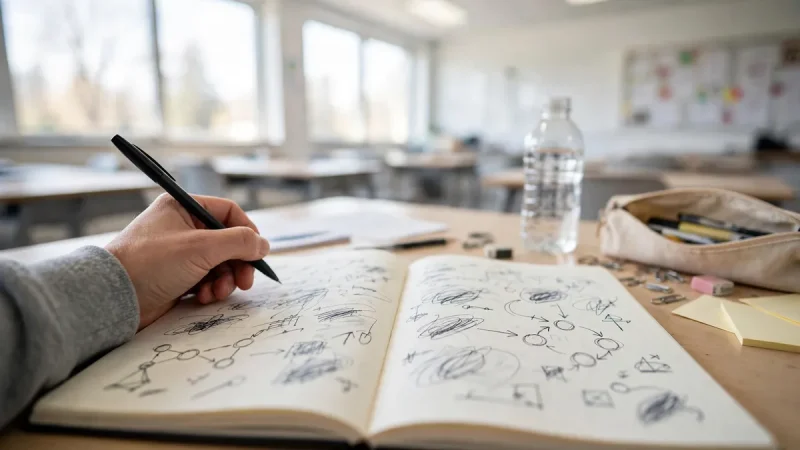

Learning how to take better notes in class changes that pattern completely. Firstly, a good method helps you listen with a clear purpose. Secondly, it helps you record ideas in your own short words. As a result, revision later feels quicker and far less stressful. You also get habits for before, during, and after every class.
Why do messy notes fail you after class?
Messy notes fail because they copy the lesson instead of explaining it. For example, many students write down every word the teacher says. That race leaves no time to think about meaning. Consequently, the page looks full, yet the ideas stay blurry.
Clear notes work in a different way entirely. Firstly, they capture the main idea in a short line. Also, they add one example that makes the idea concrete. So, your brain stores a meaning, not just a string of words. In fact, you can test this difference within one lesson.
Try this quick check after your next class. Firstly, close your notebook and explain the topic aloud. Can you explain it for one full minute? However, that gap is fixable, and the methods below fix it.
What should you do before class even starts?
Good notes actually begin before the teacher speaks. Firstly, skim the textbook pages or slides for the topic. You only need five quiet minutes for this skim. As a result, new terms sound familiar when the lesson begins.
Your seat and your tools matter more than you think. For example, a seat with a clear view reduces constant distractions. Our guide to classroom floor plan ideas shows how layout shapes focus and sightlines. Also, keep one notebook or one file per subject. Scattered pages, in contrast, waste revision time later.
Your body sets the limit for your attention span. So, eat something simple before a morning lesson whenever possible. Skipping food can dull your focus surprisingly fast, as this piece on how skipping breakfast may be harming your mental health explains. Also, keep water nearby and silence your phone completely. Small steps, therefore, protect a full hour of attention.
How do you decide what to write down in a lecture?
Students often ask one honest question in every lesson. What exactly counts as important enough to record? The answer starts with active listening in class, not fast writing. Firstly, listen for the idea the teacher keeps returning to. Teachers repeat key points, stress them, or write them up. Those signals, in fact, mark your must-write moments.
Here is a simple filter for what to write down in a lecture. Firstly, write definitions, dates, formulas, and named stages. Secondly, write examples that the teacher chooses to explain slowly. Also, write contrasts, causes, and results, because exams love them. However, skip long stories unless the story carries the point. A short cue can hold a story in memory.
How can abbreviations for faster note taking help you?
Short forms buy you precious seconds during fast explanations. For example, write “govt” for government and “info” for information. Also, use arrows for causes and the plus sign for additions. Your own system works, provided you understand it next week.
Consistency keeps those short forms useful over time. Firstly, keep one small abbreviation list inside your notebook cover. Secondly, add new symbols only when a word repeats often. As a result, your speed grows without hurting clarity later. In fact, clear short forms are core note taking tips for students in fast classes. They help you listen more and copy less.
Method one: how does the Cornell note taking method work?
The Cornell note taking method splits one page into three zones. Firstly, a narrow left column holds cues and questions. The wider right area, meanwhile, holds your main notes. Finally, a bottom strip holds a short summary in your words. That simple layout turns one page into a revision tool.
During class, you write only in the wide right area. For example, use short lines, gaps, and small headings there. After class, you fill the cue column and summary method strip. Your cues become questions that test your memory later. So, the famous cue column and summary method does the revision work. You cover the right side and answer from memory.
What does a Cornell page look like for one lesson point?
Imagine a biology lesson about photosynthesis for this example. In the main notes area, you write one short line. The line reads: plants use light, water, and air to make food. Also, you add: oxygen leaves the plant as a spare product.
Later, you turn that point into cues on the left. For example, one cue asks: what three things does a plant need? Another cue asks: what gas does the plant release afterwards? At the bottom, your summary says: photosynthesis turns light into stored food energy. Consequently, one page now holds notes, questions, and a recap.
Cornell suits lessons with clear facts and steady explanations. Firstly, it forces you to review on the same day. Secondly, it builds self-test questions without extra effort later. However, the layout needs a little setup before class starts.
Method two: how does the outline method of note taking work?
The outline method of note taking arranges ideas like a family tree. Firstly, main topics sit at the left margin without indentation. Supporting points then sit slightly indented beneath each topic. Details, meanwhile, sit one step further to the right. As a result, the page shows how ideas connect at a glance.
Take the same photosynthesis point in outline form now. Your main line reads: photosynthesis — how plants make food. Beneath it, an indented line lists the inputs: light, water, air. Another indented line lists the outputs: food energy and oxygen. A deeper detail adds: this process happens inside green leaves.
Outlines shine when a teacher speaks in a tidy order. For example, history lessons and textbook chapters often follow clear sequences. However, a messy or fast discussion can break the neat structure. In that case, leave gaps and tidy the order afterwards.
Method three: how does the mind mapping notes technique work?
The mind mapping notes technique starts from the centre of the page. Firstly, you write the main topic inside a central circle. Branches then grow outward for each big subtopic or theme. Smaller twigs, in turn, hold examples, dates, and short details. So, the whole lesson becomes one connected visual picture.
Picture the photosynthesis map for a moment in your mind. “Photosynthesis” sits in the centre circle of the page. One branch reaches out towards “inputs” with three short twigs. Another branch reaches towards “outputs” and another towards “conditions.” Also, a small sun sketch can sit beside the light twig.
Maps suit visual thinkers and topics with many linked parts. For example, essay planning becomes easier from one clear map. However, maps can crowd quickly during very fast lectures. In that case, draft a rough map and redraw it later.
In fact, the collection of sayings about special education celebrates exactly that diversity of learning styles. Your best method is simply the one you keep using.
Method four: how do charting method notes organise comparisons?
Charting suits lessons that compare several things side by side. With charting method notes, you draw a table before class begins. Firstly, each column holds one category, item, or time period. Rows, meanwhile, hold the features you need to compare across. As a result, similarities and differences jump off the page.
Use the same biology lesson to picture a simple chart. Your columns could cover plants in sun and plants in shade. Rows could cover growth speed, leaf colour, and food production. In class, you drop short facts into the matching cells. Later, revision becomes a quick scan across each row.
Charts work beautifully for science, geography, and language comparisons. For example, verb tenses sit neatly inside a language chart. However, you must predict the categories before the lesson starts. A wrong guess, therefore, means redrawing the table after class.
Method five: how does boxing method note taking work?
The boxing method note taking groups related points inside drawn boxes. Firstly, you give each subtopic its own separate box. Inside the box, you write only points about that subtopic. As a result, unrelated ideas never tangle together on the page. The finished page looks like a set of tidy panels.
Return once more to the photosynthesis lesson for this method. One box holds “inputs” with light, water, and air inside. Another box holds “outputs” with food energy and oxygen inside. A third box holds “where it happens” with leaves and sunlight. Each box, therefore, stands alone as a mini revision card.
Boxing suits students who feel overwhelmed by dense full pages. For example, each box gives your eyes one clear stopping point. However, boxes can waste space when a topic has few parts. Still, many students find the clean panels calming and clear.
Which method should you choose for each class?
No single method wins for every subject or teacher. Firstly, match the method to the shape of the lesson. Secondly, match the method to how your own brain works. The table below gives you a quick starting guide.
| Method | Best for | Watch out for |
|---|---|---|
| Cornell | Fact-heavy lessons, self-testing | Needs page setup first |
| Outline | Ordered lectures, chapters | Breaks in messy discussions |
| Mind mapping | Linked topics, essay planning | Crowds during fast talks |
| Charting | Comparisons, categories | Needs categories in advance |
| Boxing | Clear subtopics, calm pages | Uses extra page space |
Your choice can also change week by week, quite happily. For example, chart a comparison lesson and map a brainstorming lesson. Also, many adult learners mix methods across one demanding course. The flexible approach behind BCIT adult education shows how structured programmes reward adaptable study habits. So, experiment for two weeks before you judge any method.
Support also exists when notes alone cannot close a gap. For example, specialists assess learning needs and build support plans. The pathway into educational diagnostician careers shows how that support work operates professionally. Asking a teacher early, in fact, beats struggling silently for months. Good students, therefore, treat questions as a study tool too.
How do you take notes from a textbook without copying it?
Textbook notes fail when you copy paragraphs word for word. Learning how to take notes from a textbook starts with reading first. Firstly, read one full section without writing anything at all. Secondly, close the book and write the gist from memory. As a result, your notes hold understanding, not copied sentences.
Headings inside the chapter give you a ready-made skeleton. For example, turn each heading into a question before reading deeply. Your notes then become short answers under each heading question. Also, add the book example that makes each answer clear. Diagrams, meanwhile, deserve a quick sketch rather than a description.
Your wording matters more than your handwriting here, honestly. Firstly, rewrite every key point in your own simple words. Secondly, mark any point you still cannot explain clearly. So, textbook time also prepares you for better listening tomorrow.
Handwritten notes vs typed notes: which suits you better?
The handwritten notes vs typed notes debate has no single winner. Handwriting slows you down, so you summarise instead of transcribing everything. That slower pace, in fact, pushes you to choose key points. Typed notes, in contrast, capture far more words per minute. Speed helps when a teacher shares dense slides very quickly.
Your subject should guide this choice more than habit should. For example, maths and science suit paper because symbols flow freely. Long essays and research, meanwhile, suit typing and easy editing. Also, typed notes allow quick searching before an exam period. Handwritten pages, however, often stay in memory more vividly.
A hybrid routine suits many students better than either extreme. Firstly, write by hand during class for focus and selection. Secondly, type a clean summary later during your review session. As a result, you gain both understanding and a searchable record.
How do you review notes after class so they stick?
Notes only pay off when you revisit them soon afterwards. Understanding how to review notes after class starts on the same day. Firstly, spend ten minutes rereading and filling any gaps. Secondly, add the summary strip or headings you skipped earlier. As a result, the lesson stays fresh instead of fading overnight.
Self-testing beats silent rereading almost every single time. For example, cover your notes and answer your cue questions aloud. Also, teach the topic to a friend or an empty chair. Gaps appear instantly when you try to explain something clearly. Those gaps, therefore, tell you exactly what to restudy next.
Breaks protect the quality of your review sessions too. For example, short walks and real food restore tired attention. The practical advice in these fitness and nutrition tips fits study days surprisingly well. Also, review in short sessions across the week, not one marathon. Spaced sessions, in fact, feel easier and stick better.
How do you organise study notes and prepare for exams?
A term of notes becomes useless when pages hide from you. Learning how to organise study notes starts with one home per subject. Firstly, keep one notebook, binder, or folder for each subject. Secondly, date every page and title every single lesson clearly. As a result, you can find any topic within seconds.
Colour can help, provided you keep the system very simple. For example, use one colour only for definitions and formulas. Another colour can mark examples that teachers explained in detail. Too many colours, however, turn revision into slow decoding work. So, keep the code small enough to remember without thinking.
How do you take notes for exams during revision?
Exam notes differ from class notes in one key way. Learning how to take notes for exams means shrinking, not expanding. Firstly, condense each topic onto one summary page or card. Secondly, keep only definitions, steps, formulas, and classic examples there. As a result, your final week review stays calm and focused.
Practice questions should shape those summary pages from the start. For example, note the points that past questions keep testing. Also, write common traps beside the correct idea in red. Similarly, group weak topics together for one extra review round. Your summary pages, therefore, mirror the exam, not the textbook.
Older students often balance study with jobs and family duties. In fact, strong notes protect their limited study time most. The range covered in education degree job opportunities shows where teaching and learning skills can lead professionally. Whatever your stage, organised notes quietly compound in value daily.
What are the note taking mistakes to avoid?
Certain habits quietly sabotage even hardworking students every term. Knowing the common note taking mistakes to avoid saves real marks. Firstly, many students copy slides word for word without thinking. The page fills up, yet understanding never actually shows up. Secondly, many students never reread their notes after class.
Other mistakes hide inside otherwise tidy and neat notebooks. For example, some students write without dates, titles, or gaps. Later, they cannot tell where one lesson ends. Also, some students highlight everything, so nothing stands out anymore. Highlighting, in fact, only works when you stay selective.
Here is a fast self-check you can run weekly. Firstly, can you find any topic within thirty seconds flat? Secondly, can you explain each page without reading it word-for-word? If answers feel shaky, adjust the method, not your effort.
Frequently asked questions
Which note taking method is best for beginners?
Cornell suits most beginners because the layout guides you step by step. Firstly, the page itself reminds you to summarise and self-test. Also, the structure works across almost every school subject easily. Start there, and switch only after two honest weeks.
Should you rewrite your notes neatly after class?
Only rewrite when the rewrite adds understanding or fills gaps. For example, typing a short summary during review adds real value. Copying pages purely for neatness, however, wastes precious study time. So, summarise and self-test instead of chasing perfect pages.
How long should you spend reviewing notes each day?
Ten to fifteen focused minutes per subject usually works well. Firstly, reread the page and complete any missing summary strip. Secondly, answer your own cue questions without peeking first. Short daily sessions, as a result, beat one long weekly cram.
Can you mix two note taking methods together?
Yes, mixing methods often produces the strongest personal system overall. For example, outline during the lecture and map during revision. Also, chart only the comparison parts inside an outline page. Your system, therefore, should follow the lesson, not rigid rules.
What should you do when a teacher talks too fast?
Write cues and key words, then fill gaps immediately afterwards. Firstly, capture definitions, examples, and anything the teacher repeats twice. Secondly, compare pages with a classmate straight after the lesson. Also, ask the teacher to clarify the muddiest point early.
How do you know if your notes are actually good?
Good notes let you explain the lesson without the textbook open. For example, you can answer your cue questions from memory alone. Also, you can find any topic within seconds during revision. If both tests pass, your method works for you.

