
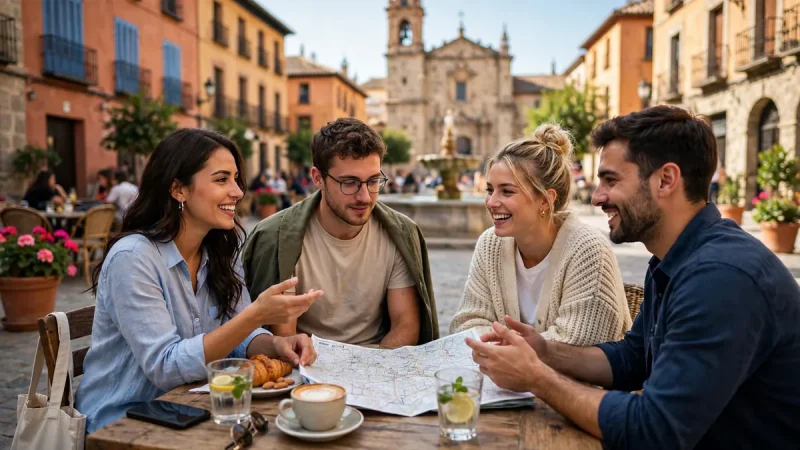

You are planning a day out with Spanish speakers. Breakfast is finished, and everyone looks at you expectantly. How do you ask what places they want to visit today in Spanish? Honestly, one friendly question unlocks the whole day. That question is ¿Qué lugares quieres visitar hoy? This lesson teaches you to say it confidently.
First, we break the question into small friendly pieces. Then we practise it inside real travel dialogues together. After that, you will swap places and days easily. Finally, fun exercises will test your new skills gently. No grammar degree is required here, so relax. Ready to sound helpful, curious, and almost local?
The Core Question, Piece by Piece
Here is the full question in Spanish. ¿Qué lugares quieres visitar hoy? Say it slowly first, then say it naturally. A friendly tone matters more than perfect speed. Locals respond warmly to travellers who try politely. That effort opens conversations far beyond this question.
Now let us unpack each word carefully together. Qué means what, and it carries an accent mark. Lugares means places, from the singular word lugar. Quieres means do you want, for one friend informally. Visitar means to visit, and it stays unchanged here. Hoy simply means today, so the day feels immediate.
Pronunciation becomes easy with this friendly guide below. Qué sounds like keh, with a short punch. Lugares sounds like loo-GAH-res, stressing the middle part. Quieres sounds like kee-EH-res, gliding smoothly together. Visitar sounds like bee-see-TAHR in most Spanish accents. Hoy sounds like oy, just like the English word.
Try this practice rhythm for one minute now. Say the words separately, then join two words together. Next, join three words, then say the full question. Record yourself on your phone if possible, too. Listening back reveals progress surprisingly quickly for learners. Repeat the full question five times with a smile.
- Qué — what?
- lugares — places
- quieres — do you want?
- visitar — to visit
- hoy — today
How to Answer the Question Naturally?
Questions feel easier when answers feel ready too. The simplest answer starts with quiero visitar. Quiero means I want, so the pattern mirrors perfectly. For example, quiero visitar el museo means one museum plan. Add a place name, and your sentence works. Simple answers build confidence faster than long speeches.
Here is a model dialogue at a hotel breakfast. Ana asks her friend Marco about their plans. Notice how short and natural each line feels. Real conversations rarely use long textbook sentences anyway. Steal these lines directly for your own trips.
Ana: ¿Qué lugares quieres visitar hoy?
Marco: Quiero visitar el castillo y el mercado.
Ana: ¿Y por la tarde?
Marco: Por la tarde, quiero descansar en la plaza.
Marco wants the castle and the market today. Later, he wants to rest in the square. Por la tarde means in the afternoon here. That phrase extends your planning beyond the morning. Also notice y, which simply means and here.
Want to sound even more natural and relaxed? Add yo prefiero for I prefer sometimes instead. Prefiero la playa means you prefer the beach. Quiero ir a means I want to go to. Ir means to go, so destinations follow naturally. These small swaps make your Spanish feel alive.
Places Vocabulary You Can Drop Straight In
Vocabulary turns one question into twenty conversations. Learn the places below, and plans form instantly. El museo means the museum in Spanish. La playa means the beach, warm and simple. El castillo means the castle on the hill. El mercado means the market, full of snacks.
Parks and views also deserve quick attention here. El parque means the park for relaxing walks. El mirador means the viewpoint above the town. La catedral means the cathedral in the centre. El barrio antiguo means the old town quarter. La plaza mayor means the main square there.
Nature words help outside the big cities too. La montaña means the mountain for hiking days. El río means the river through the valley. El lago means the lake for calm afternoons. La isla means the island across the water. Together, these words cover most holiday conversations easily.
Now build three answers using the pattern aloud. Say quiero visitar la playa with real feeling. Then swap playa for museo and castillo quickly. Finally, add hoy or mañana at the end. Mañana means tomorrow, so future plans appear instantly. Can you feel the pattern clicking into place?
Changing the Question for Different People
Travel groups rarely involve just one friend. Groups need queremos, which means we want together. ¿Qué lugares queremos visitar hoy? asks the whole group playfully. That version suits families planning days out together. Children enjoy answering it at breakfast every morning. It turns planning into a small daily game.
Formal situations need a small polite adjustment instead. Quiere usted replaces quieres for respected strangers politely. ¿Qué lugares quiere visitar hoy? suits hotel staff conversations. Spanish speakers appreciate that extra courtesy very much. When unsure, choose the formal version first, always. People will relax the tone if appropriate.
Talking about someone else needs quiere as well. ¿Qué lugares quiere visitar hoy? can also mean another person. Context and pointing usually clarify the meaning quickly. For two friends, quieren covers they or you-plural. Latin America uses ustedes for plural groups mostly. Spain often uses queréis with close friends informally.
Here is a second dialogue inside a family car. Mum asks everyone about the day ahead. Dad answers for himself, then their daughter replies. Notice queremos appearing when the family decides together. Listen for the rhythm rather than memorising rules.
Mum: ¿Qué lugares quieren visitar hoy?
Dad: Yo quiero visitar el mirador.
Daughter: Yo prefiero el parque y la heladería.
Mum: Perfecto, ¿y qué queremos visitar mañana?
Did you spot the ice cream shop there? Heladería means ice cream shop, a vital word. Priorities differ across generations, and Spanish reveals them. That tiny exchange shows real family negotiation beautifully. Practise it aloud with different family roles tonight.
Using the Question on a Real Trip to Spain
Imagine landing in Spain with this question ready. Your hostel friends gather around a morning map. You ask the question, and suggestions start flying. Someone wants Gaudí, while another wants the beach. Suddenly, the group has a real plan forming. Language, therefore, becomes your best travel tool here.
Your phrase works across the Spanish-speaking world too. Hosts in Mexico will understand it perfectly well. Families in Puerto Rico also use it daily. Our guide to places to visit in Puerto Rico with family pairs nicely here. Similarly, the interesting places to visit in the Dominican Republic inspire answers there.
Planning the Spain leg of your trip next? Browse what are some places to visit in Spain for destination ideas first. Then return here and name them in Spanish. That two-step method builds vocabulary with real motivation. Afterwards, the top 15 places to visit in Europe can extend your route. Dreamers also love browsing the top most visited places in the world for future trips.
Try This: Practice Exercises With Answers
Practice turns recognition into real speaking skill quickly. Exercise one asks you to translate a sentence. How would you say I want to visit the beach today? Think first, then check the answer below. The answer is quiero visitar la playa hoy. Notice hoy sitting comfortably at the end there.
Exercise two changes the person in the question. How would you ask a group of friends together? The answer is ¿qué lugares quieren visitar hoy? Quieren covers the group without extra words needed. Exercise three then changes only the day itself. How would you ask about tomorrow instead of today? Simply swap hoy for mañana at the end.
Exercise four builds a polite hotel conversation slowly. You ask reception about their own city recommendations. Start with buenos días and a warm smile. Then ask ¿qué lugares quiere visitar hoy? Wait, that asks about their plans, so adjust slightly. Better phrasing is ¿qué lugares me recomienda visitar hoy? Recomienda means do you recommend, a golden travel word.
Finally, exercise five is a speaking challenge today. Ask your travel partner the core question aloud. Let them answer with two places minimum today. Then swap roles and answer in Spanish yourself. Repeat tomorrow with mañana and two new places. Small daily reps beat one long study session.
- Say the core question aloud five times daily.
- Learn two new place words every morning.
- Answer with quiero visitar plus one place.
- Ask the group version at breakfast daily.
- Use recomienda when asking locals for advice.
Polite Extras That Make the Question Land Better
A question lands better with warm words around it. For example, buenos días softens any morning conversation immediately. Por favor also helps, because politeness travels everywhere. Gracias, meanwhile, closes exchanges with genuine warmth afterwards. In fact, tone often matters more than grammar. Locals, therefore, forgive small mistakes from polite learners.
Also add a reason after your question sometimes. For instance, porque es nuestro primer día explains curiosity. Porque means because, so your motive becomes clear. Similarly, nunca he estado aquí means a first visit. Nunca means never, and the phrase invites advice. Hosts, as a result, often share personal favourites.
However, listening matters just as much as asking. After the answer, repeat one place name aloud. That repetition, in contrast, confirms you understood correctly. Then ask ¿está lejos? to check the distance. Lejos means far, while cerca means near instead. Finally, ¿cómo llegamos? asks how you get there together.
Try combining everything into one confident breakfast moment. First, greet everyone warmly with buenos días, amigos. Then ask the core question with a smile. After that, answer with your own two places. Finally, suggest one shared plan for the afternoon. Does that sequence feel doable on your trip?
Common Mistakes and How to Fix Them?
Learners often drop the accent on qué accidentally. That accent separates what from that in writing. Speech stays clear anyway, so relax about it. Another common slip involves using querer incorrectly here. Remember quiero for yourself and quieres for friends. That pair solves most beginner problems very quickly.
Word order also trips English speakers at first. Spanish happily places hoy at the end. English speakers sometimes force today into the middle. Both versions communicate, yet the ending sounds natural. Similarly, articles matter before most place nouns here. Say la playa, not just playa, in sentences.
False friends deserve one quick warning too. Actual means current, not actually, in Spanish. Éxito means success, not exit, surprisingly enough. Salida means exit when you need doors. These details matter less for today’s question, thankfully. Still, they save confusion inside stations and museums.
Couples planning romantic stops can browse the most romantic places in Europe to visit together. Book lovers can also explore the 1001 Places to Visit Before You Die book for lists. Naming those places in Spanish doubles the learning. Try describing one dream stop aloud right now. Did the sentence come out smoother this time?
So how do you ask what places do you want to visit today in Spanish? You now own the question, answers, and variations. ¿Qué lugares quieres visitar hoy? carries your whole day. Use it at breakfast, in taxis, and everywhere. Ask it warmly, listen carefully, and enjoy exploring together.

