
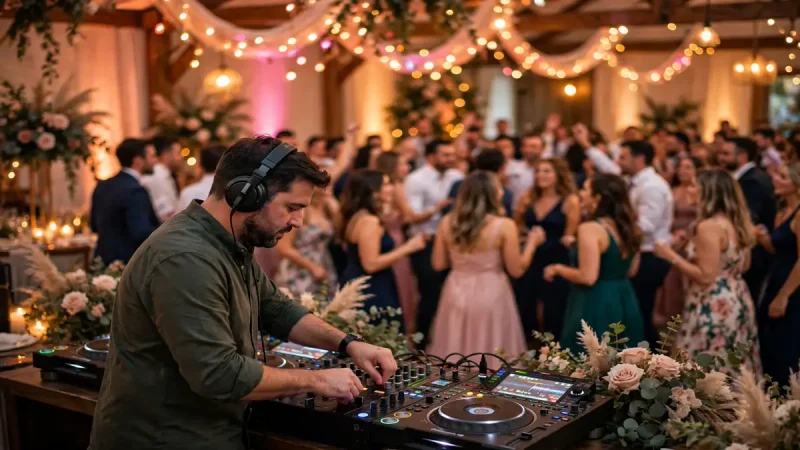

You will learn what great DJs cost, the essential questions to ask, red flags to avoid, and how to get the most from your investment. Additionally, you will find a booking timeline. Let us find your perfect DJ.
How Much Does a Wedding DJ Cost?
In the U.S., professional wedding DJs typically charge $800–$2,500. Basic services run $800–$1,800, while premium packages in major cities reach $3,000–$6,000+. Industry experts recommend allocating 8–10% of your total wedding budget to entertainment.
Lighting upgrades add $300–$600; full production with custom lighting and effects runs $700–$1,500+. In addition, ceremony sound setups, photo booths, and overtime cost extra. Always get itemized quotes — beware low base rates hiding essential add-ons.
A full-time wedding specialist costs more than a part-time newcomer, and rightly so. Furthermore, skimping on entertainment directly impacts guest enjoyment — the core goal of your celebration.
When to Book Your DJ
Book 9–12 months before your wedding, especially for spring and fall dates. The best DJs fill calendars a year out. In addition, early booking lets your DJ tailor music and lighting to your theme.
For off-season or weekday weddings, 6 months usually suffices. However, waiting until the final months limits options and may force settling for less experienced talent. Once your date and venue are set, the DJ should be next on your list.
How to Find Great Candidates
Start with referrals. Ask recently married friends, your venue coordinator, and other vendors. Planners and photographers see DJs in action constantly — their recommendations carry weight. In addition, venue-preferred lists mean the DJ already knows your space.
Read reviews and watch videos. Do not rely on photos alone. Sample videos reveal how the DJ interacts with guests, manages transitions, and handles announcements. Furthermore, look for clear communication, smooth pacing, and energy management.
Meet at least three DJs. Personality fit is crucial — if you would not enjoy dinner with them, they are wrong for your event. In addition, comparing three consultations sharpens your sense of what great looks like.
Essential Questions to Ask
- How many weddings do you perform annually? (Look for 20–50+ with 3+ years of wedding-specific experience.)
- Can you share video samples and recent references from couples and vendors?
- What equipment do you bring, and what backup systems do you maintain?
- What is your backup plan if you cannot make it — illness, emergency?
- Do you carry liability insurance? (Many venues require it.)
- Will you coordinate with our other vendors — caterer, planner, photographer?
- How do you handle music selection, requests, and do-not-play lists?
- Are you comfortable as emcee? How involved will you be on the mic?
- What exactly is included versus extra — travel fees, overtime, setup time?
- Have you worked at our venue before?
Listen for specific, confident answers. Vague responses about crowd-reading or equipment are red flags. Furthermore, responsiveness during the inquiry stage predicts wedding-day reliability.
Red Flags to Avoid
Demanding full payment upfront. Standard practice is a 20–50% deposit with the balance due before or after the event. Full upfront payment is a warning sign.
No written contract. A proper contract covers services, payment schedules, cancellation policies, and contingency plans. Never book without one. In addition, verbal promises mean nothing if problems arise.
No backup equipment. Professional DJs carry backup gear and power sources. “What happens if your equipment fails?” should get a detailed answer, not a shrug.
Choosing on price alone. The cheapest DJ often means outdated equipment, no insurance, and limited experience. Furthermore, your DJ shapes the entire reception — this is not the place to cut corners.
Getting the Most From Your DJ
Share your vision early. Provide a detailed music wishlist, must-play songs, and do-not-play list. In addition, communicate guest dynamics — age ranges, cultural mixes, sensitive relationships.
Designate a point person. A planner or trusted friend relays instructions while you are getting ready. Furthermore, this keeps you present in your own celebration.
Trust their expertise. A skilled DJ reads the room and pivots when a song is not landing. Micromanaging the playlist undermines the very skill you hired.
Tip appropriately. For excellent service, 15–20% is standard, given privately on the wedding day. In addition, a glowing review afterward is priceless for their business.
Frequently Asked Questions
How far in advance should I book a wedding DJ?
9–12 months for peak season (spring/fall); 6 months for off-season or weekdays. The best DJs book a year out, so start once your date and venue are confirmed.
Should the DJ also be the emcee?
Most wedding DJs do both — announcements, introductions, and guiding transitions. Confirm they are comfortable on the mic and discuss how involved you want them to be.
Can I just use a Spotify playlist instead?
You can, but playlists lack real-time crowd reading, emcee duties, professional sound management, and licensed music (many venues require it). Furthermore, dead air during equipment issues has no fix without a pro.
Do I need to tip my wedding DJ?
Tipping 15–20% is customary for outstanding service. It is appreciated rather than mandatory, but for a vendor who shapes your whole reception, generosity is warranted.
What is included in a standard DJ package?
Typically: sound system, microphones, 4–6 hours of performance, emcee services, and setup/teardown. Lighting, ceremony coverage, and photo booths are common add-ons. Always confirm in writing.
Conclusion
The right DJ turns a wedding into a celebration guests remember for years. Find and hire the best wedding DJ by starting early, asking sharp questions, and trusting your gut. Happy planning!
For more wedding and lifestyle guides, explore our lifestyle section.
When planning a significant event like a wedding, it’s essential to consider how the environment influences not just the mood but also the overall experience of your guests. Just as a well-curated playlist can elevate the energy of your celebration, the physical layout of a space—be it a reception hall or a classroom—plays a crucial role in facilitating interaction and engagement. This is particularly true in educational settings, where optimal layouts can enhance learning outcomes. For those interested in maximizing the effectiveness of their teaching environments, exploring various classroom floor plan ideas can provide valuable insights into how different arrangements can cater to diverse learning styles and preferences, similarly to how a skilled DJ tailors their set to the audience’s vibe. Understanding these dynamics can help ensure that both your wedding and any educational endeavors leave a lasting impression on all participants.

