
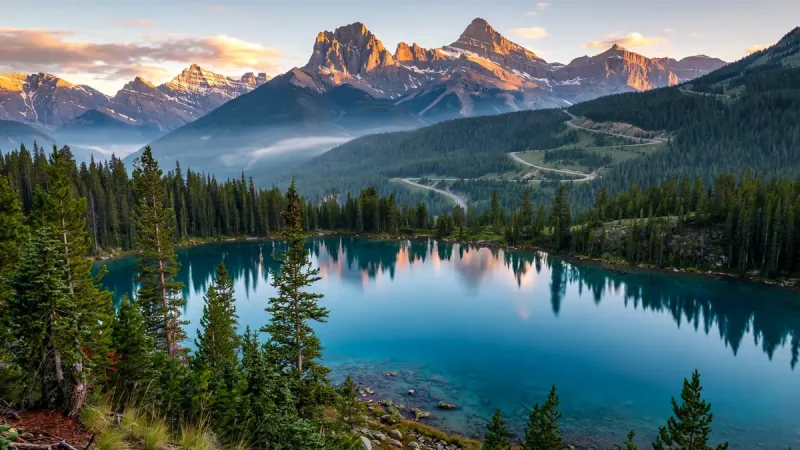

You will meet five superstar parks, a handful of legendary drives, and gateway towns worth far more than a fuel stop. Distances here are vast, however, so the art lies in choosing one or two clusters and savouring them properly. A rushed Rockies trip, paradoxically, shows you almost nothing. Slow down, and the mountains start talking.
Seasons shape everything in this region too. High roads typically open only in summer, while winter transforms the same valleys into ski country. Plan around that rhythm, and check conditions locally before any high-country drive.
The Southern Rockies: Colorado Sets the Tone
Most road trips begin in Denver, the region’s great gateway city. The Mile High City works as a soft landing, with museums, breweries, and sports stadiums filling your acclimatisation day. Altitude is real here, even in the city, so take the first day gently. Drink water constantly, skip the extra cocktail, and let your lungs adjust.
From Denver, the mountains rise within an hour’s drive. Our dedicated guide to places to visit in Rocky Mountain National Park, Colorado covers that park in depth. Within it, Trail Ridge Road climbs higher than any other continuous paved road in the United States, crossing tundra where marmots whistle beside alpine flowers. Views stretch so far that neighbouring states seem within reach.
Estes Park, the park’s eastern gateway, mixes fudge shops with elk wandering through town like they own it. In autumn, bull elk bugle in the meadows, a wild, eerie soundtrack you never forget. Meanwhile, summer side trips in our guide to places to visit near Denver in summer round out the city base nicely.
Beyond the national park, Colorado keeps dealing aces. Aspen and Breckenridge pair skiing fame with summer wildflower trails, while the Great Sand Dunes pile North America’s tallest dunes against the Sangre de Cristo peaks. Mesa Verde, in the southwest corner, preserves Ancestral Puebloan cliff dwellings of astonishing sophistication. Give Colorado a full week if you can, because it quietly becomes the trip’s highlight for many travellers.
Wyoming: Tetons First, Then Yellowstone’s Wonderland
Grand Teton and Jackson
Northbound drivers meet the Tetons with a gasp, guaranteed. These jagged peaks erupt straight from the Jackson Hole valley floor, no foothills, no warning, just granite drama. Grand Teton National Park protects that valley, where moose graze willow flats and the Snake River braids through cottonwoods. Jenny Lake, sparkling beneath the peaks, anchors the park’s best short hikes and boat shuttles.
Jackson, the valley’s main town, balances cowboy bars and serious art galleries with surprising ease. The antler arches on its town square make an irresistible photo stop. Stay a night here, rather than rushing north, because dawn light on the Tetons rewards early risers spectacularly. Photographers famously line up at Mormon Row’s old barns for exactly that shot.
Yellowstone, the original
An hour north, Yellowstone rewrites your sense of what Earth can do. The world’s first national park guards geysers, rainbow hot springs, a vast canyon, and wildlife in almost absurd abundance. Old Faithful performs on a predictable schedule, yet the quieter geyser basins often steal the show. Grand Prismatic Spring, viewed from its overlook trail, looks digitally enhanced in real life. It is not, amazingly.
Wildlife watching peaks in the Lamar Valley, often called America’s Serengeti. Bison herds block roads with total indifference, wolves hunt at dawn in season, and bears patrol the meadows. Rangers and regulars alike stress distance, since these animals are wild and powerful. Bring binoculars, pull fully off the road, and let the valley perform.
Road-trippers collecting the continent’s wildest scenery should also browse our collection of scenic places to visit in the US afterwards. Similarly, our gallery of surreal places to visit in the US will feel like Yellowstone’s family album.
Montana: Glacier Country and Big-Sky Towns
Glacier National Park crowns Montana, hard against the Canadian border. Here, remnant glaciers still carve valleys between horn-shaped peaks, and turquoise lakes mirror the whole production. Going-to-the-Sun Road, the park’s engineering marvel, clings to cliff edges across the Continental Divide. It typically opens only for a short summer window, since snow buries it deeply each winter.
Drive that road slowly, using every pullout. Logan Pass, at the summit, blooms with wildflowers in midsummer and hosts mountain goats near the trails. Vehicle-length limits apply on the narrowest sections, however, so check restrictions before you set out. Alternatively, the park’s classic red tour buses let you watch scenery instead of cliff edges.
Montana’s towns add soul between the parks. Bozeman mixes a lively main street with dinosaur riches at the Museum of the Rockies, while Whitefish and Big Sky anchor ski-and-summer recreation. Missoula, meanwhile, charms with its riverfront and literary streak. Fuel up in these towns, chat with locals, and collect the diner recommendations that never reach guidebooks.
East of the divide, your route can bend toward South Dakota’s Black Hills surprisingly easily. Many travellers combine both regions in one grand loop, especially in late summer. If winter ever tempts you back this way, our guide to places to visit in South Dakota during winter shows the northern plains’ colder character.
The Canadian Rockies: Banff, Jasper, and the Icefields
Cross into Alberta and the Rockies turn up their drama another notch. Banff National Park, Canada’s oldest, wraps around the town of Banff, where elk stroll and the Bow River runs glacier-blue. Nearby Lake Louise and Moraine Lake display colours that cameras honestly struggle to believe. Arrive at those lakes early or by shuttle, since their small parking areas fill fast in summer.
The Icefields Parkway, linking Lake Louise with Jasper, might be the finest mountain drive on Earth. Glaciers spill toward the road, waterfalls thunder beside pullouts, and the Columbia Icefield spreads ice across the horizon. Jasper, at the parkway’s north end, feels quieter and wilder than Banff, with superb stargazing in its dark-sky preserve. Wildlife sightings along this corridor are common, so drive attentively at dawn and dusk.
Continuing west afterwards? Our guide to places to visit in Vancouver, British Columbia makes a perfect coastal finale. Pacific Northwest fans can likewise detour through the best place to visit in Oregon on a longer homeward route.
The Southern Tail: New Mexico’s High Country
Do not overlook the range’s southern end, where the Rockies fade into New Mexico’s high desert. Taos anchors this corner with its ancient pueblo, art colony energy, and the Rio Grande Gorge Bridge spanning a dizzying canyon nearby. Taos Ski Valley, tucked into the Sangre de Cristo Mountains, delivers steep skiing in winter and alpine hiking in summer. The Enchanted Circle scenic loop links these stops through mountain villages in one satisfying day’s drive.
Santa Fe, slightly south of the highest peaks, pairs adobe architecture with serious food and gallery scenes. Its altitude keeps summers mild, while winter brings a festive glow to the plaza. Travellers often underestimate this southern chapter, honestly, yet it adds culture that balances the wilderness further north. Green chile at lunch, for example, becomes a memory all by itself.
Colorado’s southwest corner deserves a callout here too. The Durango and Silverton Narrow Gauge Railroad still steams through the Animas River gorge, carrying passengers into roadless mountain country. Ouray, nicknamed the Switzerland of America, wedges its Victorian streets between towering amphitheatre walls. Soak in its hot springs after a day on the trails, and you will understand the nickname’s spirit completely.
Hot Springs: The Region’s Reward System
Geology gives the Rockies a glorious bonus: natural hot springs scattered along the whole range. Glenwood Springs in Colorado fills a vast, steaming pool beside the Colorado River, perfect after a hiking day. Smaller, quieter springs hide near Steamboat, Pagosa Springs, and Idaho’s mountain towns, each with its own character. Canadian travellers, meanwhile, swear by the historic pools at Banff Upper Hot Springs and Radium.
Etiquette stays simple across borders. Shower first where posted, keep voices low, and watch your step on mineral-slick stones. Winter soaks feel especially magical, since steam rises thick while snow lands on your shoulders. Check opening patterns locally, because smaller springs adjust hours seasonally. Afterwards, hydrate well, because hot water plus altitude dehydrates faster than you expect.
How Should You String It All Together?
Resist the everything loop, tempting as it looks on the map. Instead, pick one of three classic arcs and drive it properly. The Colorado arc runs Denver, Rocky Mountain National Park, Aspen, and the dunes over seven to ten days. The Wyoming-Montana arc links the Tetons, Yellowstone, and Glacier across ten days minimum. Finally, the Canadian arc pairs Banff and Jasper with the Icefields Parkway over five to seven unhurried days.
Book park-area lodging early, because gateway towns sell out for summer months ahead. Campers should reserve sites the moment booking windows open, since demand overwhelms supply in famous parks. Shoulder seasons, especially September, reward flexible travellers with golden aspens, thinner crowds, and cooler hiking weather. Elk rut season then adds its wild soundtrack across the valleys.
Driving days here deceive newcomers constantly. Mountain roads curve, wildlife wanders onto asphalt, and every second viewpoint demands a stop, so double your map’s estimate. Build buffer days into the plan, rather than stacking heroic drives back to back. You will thank yourself at the first bison jam, guaranteed.
High-Country Rules Worth Memorizing
- Respect altitude: Many passes exceed 3,000 metres, so hydrate, ascend gradually, and treat headaches as a signal to descend.
- Give wildlife room: Bears and bison need serious distance, therefore use lenses and binoculars instead of footsteps.
- Carry layers always: Summer afternoons can swing from t-shirt warmth to hail within an hour at elevation.
- Fuel up early: Stations thin out between gateway towns, especially on scenic byways and park corridors.
- Check conditions locally: Road openings, fire restrictions, and trail closures change fast, so confirm with rangers or park sites daily.
The Rockies do not fit in a weekend, a month, or honestly a lifetime of returns. What they offer instead is a lifetime supply of reasons to come back: another pass, another lake, another town diner. Start with one arc, drive it slowly, and let the mountains set your pace. By the final descent, you will already be planning the next crossing, probably before you even reach the airport. That is not a flaw in the plan, incidentally. It is simply how the Rockies work on people, season after season, generation after generation, without ever once trying too hard at all.

